
Delhi’s First Cloud Seeding Trials Fail to Trigger Rain, More Attempts Planned

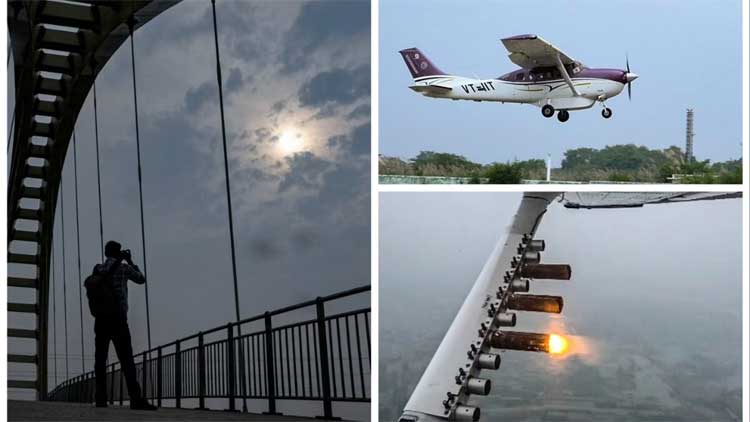
In a first-of-its-kind effort to combat Delhi’s worsening air pollution, two Cessna aircraft fitted with salt- and silver iodide-based flares took off on Tuesday — one from Kanpur and another from Meerut — to induce artificial rainfall over the national capital.
Each aircraft carried eight flares and hovered over northwest Delhi, releasing the chemicals into the clouds to trigger precipitation. However, the trials produced only light drizzles in Noida and Greater Noida, falling short of the intended goal. Officials said more such attempts are planned in the coming days.
What Happened on Tuesday
Delhi Environment Minister Manjinder Singh Sirsa said the cloud seeding trials were conducted in collaboration with IIT-Kanpur. The first aircraft, flying from Kanpur, released eight flares over areas including Burari, north Karol Bagh, and Mayur Vihar. The exercise lasted about 30 minutes.
The second aircraft, which took off from Meerut around 3:55 pm, released flares at an altitude of 5,000–6,000 feet, covering Khekra, Burari, Pavi Sadakpur, Noida, Modinagar, and Meerut.
Cost of the Trials
The two initial trials together cost approximately ₹1.28 crore, according to officials. The Delhi Cabinet had approved the cloud seeding project in May, allocating ₹3.21 crore for five trials, each costing about ₹64 lakh.
Did It Work?
While the trials did not generate substantial rainfall, officials said there was a measurable drop in particulate matter (PM2.5 and PM10) levels in the targeted areas. The IMD reported that atmospheric moisture during the trials was only 10–15%, significantly lower than the optimal levels required for cloud seeding.
Minor rainfall was recorded — 0.1 mm in Noida and 0.2 mm in Greater Noida — but the impact on Delhi itself remained negligible.
The Economics of Cloud Seeding
IIT-Kanpur Director Manindra Agrawal said the cost of cloud seeding is relatively low compared to other pollution control measures. “It costs around ₹20,000 per square kilometre. For a 1,000 sq km area, the expense is about ₹2 crore,” he said.
If carried out throughout the winter, assuming cloud presence once every 10 days, the total cost could reach ₹25–30 crore, which Agrawal described as modest compared to Delhi’s overall pollution control budget.
What’s Next?
Sirsa confirmed that 9–10 additional trials are planned over the next few days, though the lack of sufficient moisture remains a major hurdle. A trial scheduled for Wednesday was postponed after IIT-Kanpur determined that cloud moisture levels were too low for effective seeding.
“The clouds currently have only about 15–20% moisture. With such low content, the chances of inducing rain are slim,” Agrawal told NDTV.
Officials remain optimistic that future attempts, timed with more favorable atmospheric conditions, could finally bring artificial rain to Delhi.
Comments are closed.