
Delhi’s Air Quality Turns ‘Severe’; CAQM Enforces GRAP Stage-3 Restrictions Across NCR

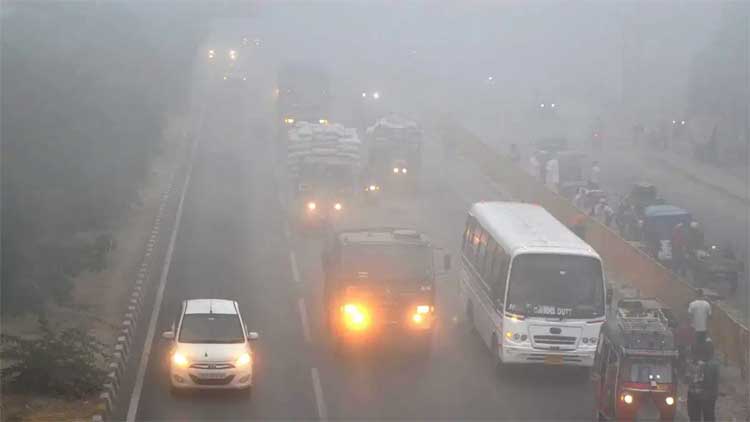
The Commission for Air Quality Management (CAQM) on Tuesday imposed Stage-3 restrictions under the Graded Response Action Plan (GRAP) as a dense haze of toxic pollutants blanketed Delhi, pushing air quality into the “severe” category for the first time this season.
Delhi’s 24-hour average Air Quality Index (AQI) stood at 421 at 7 a.m., the highest of the year so far, according to the Central Pollution Control Board (CPCB).
Under GRAP Stage-3, private BS-3 petrol and BS-4 diesel four-wheelers are banned across Delhi, Gurugram, Faridabad, Ghaziabad, and Gautam Buddh Nagar. The restrictions also extend to private construction and demolition activities, the use of stone crushers and mining operations, and the movement of non-essential diesel-operated medium and light commercial vehicles registered outside Delhi, except those carrying essential goods or providing essential services.
Schools up to Class 5 in Delhi and neighbouring districts have been directed to shift to hybrid or online lessons, while governments and municipal bodies in the NCR have been asked to stagger office timings to curb vehicular congestion.
The CAQM cited “calm winds, a stable atmosphere, and unfavourable meteorological conditions” for the sharp rise in pollution levels, noting that the AQI had further climbed to 425 by 9 a.m.
“Keeping in view the prevailing trend of air quality, and in an effort to prevent further deterioration, the Sub-Committee has invoked all actions under Stage-III of GRAP—‘Severe’ Air Quality—with immediate effect in the entire NCR,” the commission said in a statement.
Experts said the thick haze lingering since Monday was not fog but trapped pollution, worsened by low wind speeds and falling temperatures that prevented dispersion.
The situation was compounded by a technical glitch on Monday, when pollution data went missing for nearly 10 hours due to a server issue. By midnight, the AQI had breached the 400-mark, officially entering the “severe” zone for the first time since December 23, 2024, when the AQI hit 406.
At 7 a.m. Tuesday, 34 of Delhi’s 39 monitoring stations reported “severe” air quality, with the highest readings from Bawana (462), Wazirpur (460), Mundka (452), and Punjabi Bagh (452).
An AQI between 301 and 400 is classified as “very poor,” while anything above 400 is deemed “severe.”
Comments are closed.