
Cuba’s president says there are no talks with the US after Trump threats

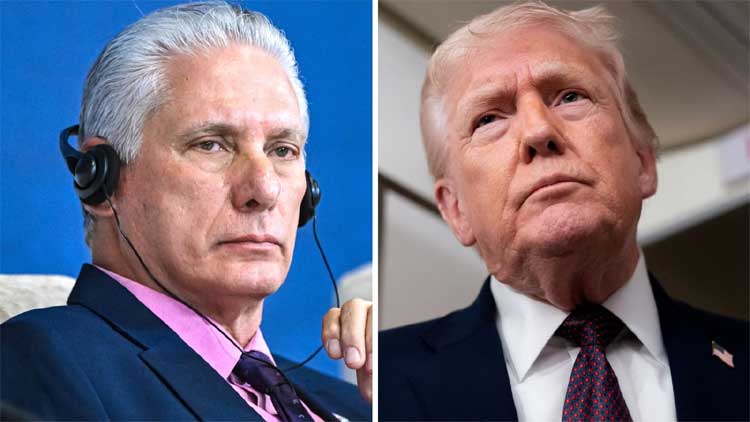
Cuban President Miguel Díaz-Canel said on Monday that his government is not holding talks with the United States, a day after President Donald Trump issued a warning to the Caribbean nation following a US attack on Venezuela.
Díaz-Canel made the remarks in a series of posts on social media platform X after Trump said Cuba should “make a deal, BEFORE IT IS TOO LATE,” without specifying what such a deal would involve.
“For relations between the US and Cuba to progress, they must be based on international law, not hostility, threats and economic coercion,” Díaz-Canel wrote. He said Cuba has long been willing to engage in “serious and responsible dialogue” with US administrations, including the current one, provided talks are grounded in sovereign equality, mutual respect, international law and non-interference in internal affairs.
Cuban Foreign Minister Bruno Rodríguez reposted the statements.
Trump on Sunday said Cuba would no longer be able to rely on oil and financial support from Venezuela, which the United States attacked on Jan. 3 in an operation that killed 32 Cuban officers and led to the arrest of Venezuelan President Nicolás Maduro.
Before the attack, Cuba was receiving about 35,000 barrels of oil per day from Venezuela, along with roughly 5,500 barrels daily from Mexico and 7,500 from Russia, according to Jorge Piñón of the Energy Institute at the University of Texas at Austin.
Mexican President Claudia Sheinbaum on Monday declined to disclose details about current oil shipments to Cuba or say whether supplies would increase as Venezuelan deliveries end. She said the assistance had been in place for years and insisted Mexico had sufficient oil, despite declining production at state-owned oil company Pemex. She added that Mexico remains willing to facilitate dialogue between Washington and Havana if both sides agree.
Cuba has faced widespread blackouts even with Venezuelan oil supplies, due to fuel shortages and an aging power grid. Analysts warn that losing access to petroleum could worsen the island’s economic crisis, which deepened during the COVID-19 pandemic and intensified under US sanctions expanded during Trump’s first term.
Cuba’s government has said US sanctions cost the country more than $7.5 billion between March 2024 and February 2025, a significant blow to an economy whose tourism revenue peaked at around $3 billion annually in the previous decade. The crisis has also fueled a surge in migration, largely to the United States, where preferential treatment for Cuban migrants has since been curtailed.
Andy S. Gómez, a senior fellow in Cuban Studies at the University of Miami, described the situation as “very sad and concerning,” saying Díaz-Canel’s comments appeared aimed at buying time rather than signaling imminent negotiations.
“They had an opportunity when diplomatic relations were restored under President Barack Obama,” Gómez said. “These are desperate times for Cuba.”
Michael Galant of the Center for Economic and Policy Research in Washington said Havana may be open to talks, particularly on issues such as migration and security, but suggested Trump was in no hurry to negotiate.
Díaz-Canel later reiterated that there are “no talks with the US government, except for technical contacts in the area of migration.”
As tensions remained high, reactions among Cubans were mixed. Some expressed concern over potential escalation, while others said they hoped any crisis might bring change. Conversations about the standoff dominated public discourse on the island and among Cubans abroad.
Comments are closed.