
Climate Crisis Accelerates Beyond Projections as Scientists Warn of Alarming New Records

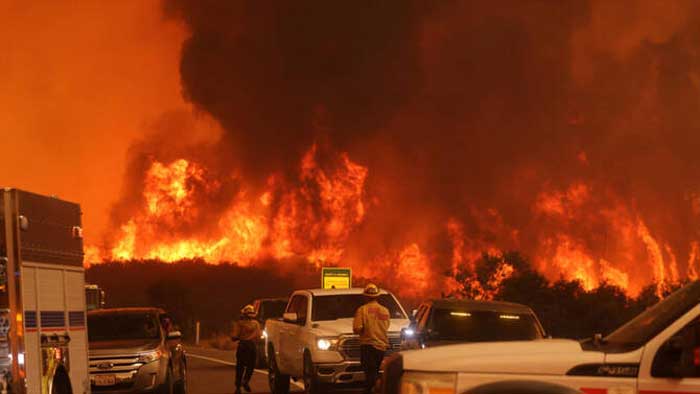
Key indicators of climate change — from record-breaking carbon emissions to surging sea levels — are now moving at a pace and scale never before recorded, more than 60 leading climate scientists warned in a major update published Thursday.
According to the peer-reviewed report, greenhouse gas emissions from fossil fuel use and deforestation reached an all-time high in 2024. Over the past decade, the planet has averaged 53.6 billion metric tons of CO₂ emissions per year — equivalent to 100,000 tons every minute.
For the first time in recorded history, Earth’s surface temperature last year temporarily breached the critical 1.5°C threshold above pre-industrial levels. Scientists estimate that humanity’s remaining “carbon budget” — the amount of CO₂ that can be emitted while still having a two-thirds chance of staying below 1.5°C — could be depleted within just a few years.
While clean energy investment has doubled that of fossil fuels, coal, oil, and gas still account for more than 80% of the world’s energy consumption, and the growth of renewables continues to lag behind increasing global demand.
The 1.5°C target, once considered an aspirational goal in the 2015 Paris Agreement, is now widely regarded as essential to avoiding the worst impacts of climate disruption. Though the agreement legally binds nearly 200 nations to limit global warming to “well below” 2°C — often interpreted as 1.7°C to 1.8°C — scientists stress that staying below 1.5°C is critical.
“We are already in crunch time for these higher levels of warming,” said Joeri Rogelj, a climate science professor at Imperial College London. “The next three or four decades is pretty much the timeline over which we expect a peak in warming to happen.”
More troubling than individual data points is the accelerating pace of change, the study emphasizes. Human-caused warming has increased over the past decade at a rate unmatched in the historical record — faster even than the 2010–2019 period highlighted in the latest UN Intergovernmental Panel on Climate Change (IPCC) report.
Published in Earth System Science Data, the new study serves as an authoritative — though unofficial — update to the IPCC’s assessments, and its authors hope it acts as a wake-up call for global leaders.
“I tend to be an optimistic person,” said lead author Piers Forster of the University of Leeds. “But if you look at this year’s update, things are all moving in the wrong direction.”
Among the most visible signs of this shift is sea-level rise. While oceans rose less than 2 mm per year from 1901 to 2018, the rate has accelerated to 4.3 mm annually since 2019. Over the past 125 years, global sea levels have risen by 23 centimeters — enough to put small island nations at risk and intensify storm surges. An additional 20 cm rise by 2050 could result in $1 trillion in annual flood damages across the world’s 136 largest coastal cities, prior studies have shown.
Underlying these climate shifts is Earth’s growing energy imbalance — the difference between solar energy absorbed and energy radiated back into space. Oceans have absorbed about 91% of this excess heat, buffering land ecosystems, but that buffering capacity may not last.
“The planet’s energy imbalance has nearly doubled in the last two decades,” the authors noted, warning that the long-term ability of oceans to absorb heat remains uncertain.
Although severe impacts are now unavoidable in the coming decades, the scientists stress that the long-term future remains within our control. “We will rapidly reach a level of global warming of 1.5°C,” said former IPCC co-chair Valérie Masson-Delmotte, “but what happens next depends on the choices which will be made.”
As the world prepares for a high-stakes climate summit in Brazil later this year, global cooperation faces renewed challenges. The United States’ exit from the Paris Agreement under President Donald Trump and the rollback of domestic climate policies have undermined global momentum, raising concerns that other nations may also hesitate to strengthen their commitments.
Despite the grim outlook, scientists insist that decisive action can still limit the worst outcomes — but the window for doing so is closing fast
Comments are closed.