
Climate Change Threatens Europe’s Underwater Heritage as Scientists Race to Protect WWII Wrecks and Coastal Sites

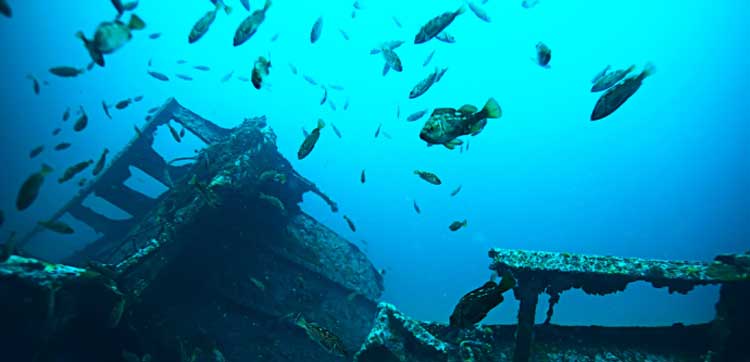
Forty metres below the surface of the Ligurian Sea lies one of Italy’s best-preserved World War II shipwrecks — the Equa, a cannon-equipped submarine chaser that sank in 1944 after being accidentally rammed by a German vessel. No lives were lost, and over the decades the wreck became a thriving habitat for marine life, drawing divers, fishers and researchers.
Today, however, the site is showing troubling signs of distress.
Rising Temperatures, Strange Currents Worry Scientists
During a dive in August 2023, researchers documented a 2°C rise in seabed temperature compared to historical averages — a significant jump for the region. Divers also encountered an unusual upward current that churned sand and silt, making 3D mapping impossible.
“These findings highlighted the need for further sampling and scientific analysis to confirm climate-driven impacts on wreck deterioration,” said Dr Angelos Amditis, R&D director at the Institute of Communication and Computer Systems (ICCS) in Athens.
Amditis leads THETIDA, a European Union–funded project running until October 2026 that is working to understand how climate change, pollution and shifting ocean dynamics are damaging Europe’s underwater cultural heritage.
Seven Sites Across Europe Under the Scanner
The Equa is one of seven pilot sites under THETIDA, spanning underwater wrecks, coastal ruins and Arctic industrial remains. The locations include:
-
Two WWII wrecks in Italy
-
A shipwreck off Cyprus
-
A WWII aircraft wreck near Portugal
-
The medieval castle of Mykonos, Greece
-
Gemaal de Poel pumping station on Lake IJssel, Netherlands
-
The Hiorthhamn coal cableway station in Svalbard, Norway
Across all sites, scientists are seeing hazards escalate.
“Climate-driven risks such as erosion and extreme weather events are intensifying,” said Dr Panagiotis Michalis, senior researcher at ICCS. “We want to provide early-warning indicators and real tools for heritage managers before irreversible damage occurs.”
But experts warn that many underwater sites remain undocumented, leaving them vulnerable.
“Wrecks and submerged settlements are degrading faster than we can study or stabilise them,” Amditis said.
Netherlands: Local Voices Shape Lake IJssel Preservation
On Lake IJssel, researchers are studying the Gemaal de Poel pumping station — a heritage structure once marked for possible demolition. Local citizens pushed back, arguing the building remained culturally significant.
“Residents felt attached to it,” said Dr Deniz Ikiz of Eindhoven University of Technology.
Through Living Labs — community workshops bringing together locals, students, authorities and heritage experts — THETIDA shaped its conservation plan around what the community considered meaningful.
A new crowdsourcing app now allows people to explore 3D models of all seven sites and report their observations in real time. Ikiz says this project could serve as a model for future heritage decision-making.
Svalbard: The Arctic’s Vanishing Industrial Past
Far north in Svalbard, researchers are studying the Hiorthhamn coal cableway station, a complex of masts, tracks, and industrial buildings from the early 20th century.
The Arctic is warming four times faster than the global average, causing permafrost to collapse and coastlines to erode. Without intervention, scientists estimate the site may disappear within 10–20 years.
The challenge goes deeper than physical decay. According to Dr Paloma Guzman of the Norwegian Institute for Cultural Heritage Research, Svalbard’s identity is shifting: coal mining has ended and communities are turning toward tourism and research.
Her work highlights a critical problem — current laws protect everything built before 1946, regardless of its meaning, condition or environmental risk.
“What matters is not whether a community is still present,” Guzman said. “It’s about re-evaluating what we consider meaningful heritage so conservation remains grounded in shared histories and values.”
Some collapsing structures could even leak industrial waste into fragile Arctic ecosystems, forcing tough decisions about whether to preserve, document or let go.
A Race Against Time — and Changing Seas
Across Europe, a larger issue looms: coastlines and underwater landscapes are changing faster than institutions can react. The THETIDA project, by integrating sensor networks, satellite data, underwater robotics and local participation, hopes to set groundwork for future policies.
Although shipwrecks, pumping stations and abandoned mines may vanish, communities continue to assert what matters to them. That, researchers say, is the foundation of meaningful preservation.
In the end, THETIDA is not just about safeguarding relics beneath the waves — it’s about building a new framework for understanding what we choose to save, what we can let go, and how climate change is reshaping that conversation in real time.
Comments are closed.