
Climate change is slowing Earth’s spin at unprecedented rate compared to past 3.6 million years

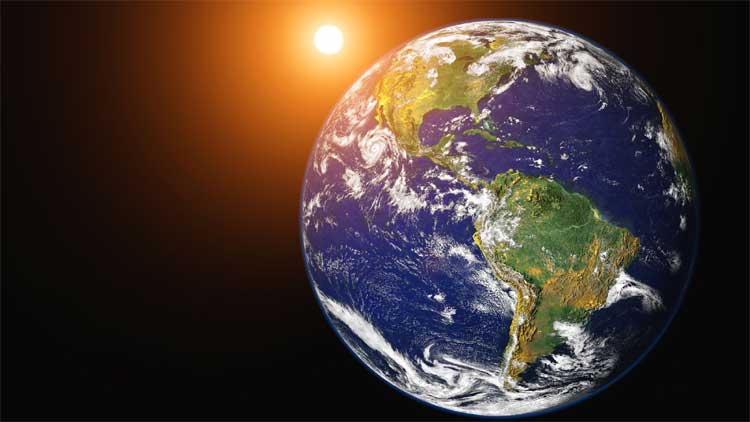
Climate change is lengthening Earth’s days as rising sea levels slow the planet’s rotation, according to new research from the University of Vienna and ETH Zurich. Scientists say the current rise in day length—about 1.33 milliseconds per century—is the fastest seen in at least 3.6 million years.
The findings, published in Journal of Geophysical Research: Solid Earth, were based on fossil evidence from benthic foraminifera, microscopic marine organisms whose chemical composition preserves clues about past sea levels and climate conditions.
How climate change affects Earth’s rotation
An exact 24-hour day is not fixed. Day length naturally changes due to the gravitational pull of the Moon and geophysical processes within Earth’s interior, surface and atmosphere.
However, modern climate change is now influencing this balance. From 2000 to 2020, melting polar ice sheets and mountain glaciers redistributed mass from land to oceans. This shift raised sea levels and slowed Earth’s rotation—similar to a figure skater spinning more slowly when they extend their arms outward.
Fossils reveal ancient day-length changes
To investigate whether such rapid changes occurred in the past, researchers analysed fossilised benthic foraminifera. Their chemical composition allowed scientists to reconstruct historic sea-level variations and calculate corresponding changes in day length.
The team also used a physics-informed diffusion model, a probabilistic deep-learning algorithm that integrates climate physics while accounting for uncertainties in paleoclimate data.
Modern change is historically unusual
During the Quaternary period (the last 2.6 million years), ice sheets repeatedly expanded and melted, causing sea-level shifts and changes in Earth’s rotation.
But the study found that the current increase in day length stands out across the last 3.6 million years. Only once—around 2 million years ago—did the rate of change approach today’s levels.
Researchers say the modern trend reflects the exceptional pace of human-driven climate change. By the end of the 21st century, climate-driven effects on day length could even exceed the influence of the Moon.
Although the difference amounts to only milliseconds, it could affect technologies that rely on extremely precise measurements of Earth’s rotation, including space navigation and satellite systems.
Comments are closed, but trackbacks and pingbacks are open.