
Climate change drives majority of wildfire emissions in western US

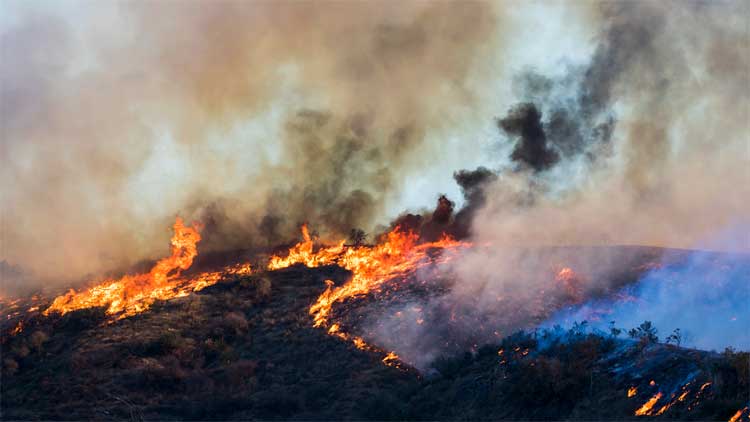
Wildfires and the dangerous smoke they generate have intensified across the western United States since the 1990s, but pinning down the exact causes has long been challenging. A new study led by Harvard researchers now provides strong evidence linking much of this increase directly to climate change.
The research, headed by Loretta Mickley, senior research fellow at Harvard’s School of Engineering and Applied Sciences, found that climate change is responsible for 60–82% of the total forest area burned in the western US and about 33% in central and southern California since the early 1990s. On average, climate change accounted for nearly 65% of total US wildfire emissions between 1997 and 2020.
The study also showed that nearly half of the most harmful wildfire smoke in the western US—fine particulate matter known as PM2.5—can be attributed directly to climate change during this period. Between 2010 and 2020 alone, climate change drove 58% of the increase in PM2.5 pollution from wildfire smoke.
To reach these conclusions, researchers combined satellite observations, machine learning techniques, and large-scale climate models. They used the GEOS-Chem chemical transport model to isolate the contribution of human-driven climate change to smoke-related air pollution. The analysis clearly demonstrated how rising temperatures, shifting weather patterns, and drier vegetation have amplified wildfire activity since the 1990s.
The team mapped ecosystems across the western US—from forested mountain regions in the Northwest and California’s Mediterranean climate zones to cold desert interiors—and analyzed decades of data on weather, vegetation, and fire extent. Machine learning models helped reveal strong links between temperature, humidity, vegetation dryness, and fire behavior.
While pollution from industrial and other non-fire sources declined by about 44% between 1997 and 2020—reflecting the success of the Clean Air Act—wildfire smoke pollution rose steadily over the same period. Northern California and parts of Oregon, Washington, and Idaho were among the hardest hit, with climate-driven wildfire smoke making up 44–66% of total PM2.5 levels from 2010 to 2020.
Researchers are now examining how decades of fire suppression in the 20th century may have worsened today’s wildfire risks. The buildup of dense forests and underbrush has likely increased available fuel, compounding the effects of climate change and boosting smoke exposure.
Mickley and her colleagues stress the urgent need for proactive land-management strategies, particularly prescribed burning in high-risk areas. Such measures can reduce excess fuel and help prevent future catastrophic fires.
The study was supported by the National Oceanic and Atmospheric Administration’s Climate Program Office. The lead author is Xu Feng, with co-authors Jed O. Kaplan, Makoto Kelp, Yang Li, and Tianjia Liu.
Comments are closed.