
China’s Foreign Minister Engages Taliban in Kabul to Bolster Regional Stability

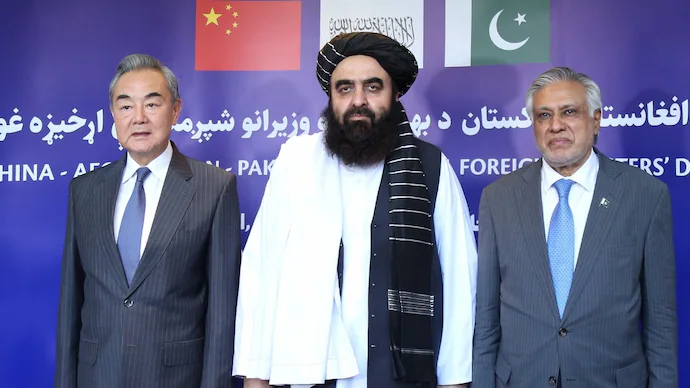
Chinese Foreign Minister Wang Yi met his Taliban counterpart, Amir Khan Muttaqi, in Kabul, marking his first visit to Afghanistan in over three years. The bilateral meeting, followed by a trilateral dialogue with Pakistan’s Foreign Minister Ishaq Dar, focused on expanding economic ties, enhancing security cooperation, and integrating Afghanistan into China’s Belt and Road Initiative (BRI) through the China-Pakistan Economic Corridor (CPEC). Amid strained Pakistan-Afghanistan relations and China’s push to secure critical mineral supplies, the visit underscores Beijing’s role as a regional mediator and economic partner. This article explores the context of the meeting, its strategic implications, challenges, and opportunities for China, Afghanistan, and the broader South Asian region.
Context of the Kabul Meeting
Bilateral and Trilateral Framework
-
Bilateral Discussions: Wang Yi and Muttaqi discussed deepening China-Afghanistan cooperation in trade, mining, and infrastructure. With annual bilateral trade reaching $1 billion, Muttaqi proposed joint commissions to enhance transportation, banking, and trade balance, while Wang pledged support for Afghanistan’s reconstruction and BRI participation.
-
Trilateral Dialogue: The sixth China-Afghanistan-Pakistan Foreign Ministers’ Dialogue, held on August 20, 2025, reviewed prior commitments from a May 2025 Beijing meeting. It emphasized political trust, economic connectivity, and counterterrorism, with a focus on extending CPEC to Afghanistan.
-
Regional Dynamics: The meeting occurred against a backdrop of warming Pakistan-Afghanistan ties, facilitated by China’s mediation, following tensions over cross-border terrorism and Afghan refugee expulsions by Pakistan.
Strategic Objectives
-
CPEC Expansion: China aims to extend the $62 billion CPEC, a flagship BRI project, into Afghanistan to connect Central Asia with Pakistan’s Gwadar Port, enhancing regional trade and accessing Afghanistan’s mineral wealth, estimated at $1 trillion.
-
Security Concerns: Beijing seeks to address threats from groups like the Eastern Turkistan Islamic Movement (ETIM), accused of using Afghan soil to target China, and to stabilize Pakistan-Afghanistan relations to protect Chinese investments and nationals, with 20 killed in Pakistan since 2021.
-
Diplomatic Engagement: China’s advocacy for Afghanistan in multilateral forums, such as supporting the release of frozen Afghan assets, aims to normalize Kabul’s international relations, despite not formally recognizing the Taliban government.
Regional Context
-
China’s South Asia Strategy: Wang’s visit, following talks in India on August 19, 2025, reflects China’s broader diplomatic push to balance relations with India, Pakistan, and Afghanistan, ahead of the Shanghai Cooperation Organisation (SCO) Summit in Tianjin.
-
Pakistan’s Role: Pakistan, a key Chinese ally, upgraded diplomatic ties with Afghanistan by appointing an ambassador in May 2025, facilitated by China’s mediation, signaling progress in bilateral relations.
Implications of the Meeting
Economic Impact
-
Trade and Investment: China’s commitment to expand Afghan exports and initiate mining projects, such as copper and lithium, could boost Afghanistan’s economy, currently reliant on $1 billion in annual Chinese trade.
-
CPEC Integration: Extending CPEC to Afghanistan could create infrastructure and jobs, with potential railway links from Central Asia to Pakistan, supporting Afghanistan’s $3 billion export market.
-
Regional Connectivity: Enhanced trade corridors align with BRI’s goal of connecting Asia, Africa, and Europe, potentially increasing regional trade volumes by 15% by 2030.
Geopolitical Significance
-
China’s Mediation Role: By facilitating Pakistan-Afghanistan dialogue, China strengthens its position as a neutral broker, reducing regional tensions and securing its investments, critical for the 20,000 Chinese nationals in Pakistan.
-
Counterterrorism Cooperation: Joint efforts against groups like the Tehreek-e-Taliban Pakistan (TTP) and ETIM could stabilize the region, addressing Pakistan’s concerns about 737 deaths from terrorist attacks in 2025.
-
Global Influence: China’s support for Afghanistan’s diplomatic normalization enhances its leadership in South Asia, countering U.S. influence post-2021 withdrawal.
Social and Developmental Impact
-
Afghanistan’s Reconstruction: Chinese investments in mining and infrastructure could improve livelihoods, addressing Afghanistan’s 90% poverty rate, though benefits depend on equitable distribution.
-
Regional Stability: Improved Pakistan-Afghanistan ties, backed by China, could reduce cross-border violence, fostering peace in a region marked by 502 militant attacks in 2025.
Challenges
Security Risks
-
Ongoing Violence: Afghanistan’s volatile security, with a 5% rise in militant attacks in 2025, threatens Chinese investments, particularly in mining and CPEC projects.
-
TTP Concerns: Pakistan’s accusations of TTP operating from Afghan soil, despite Taliban denials, complicate trilateral counterterrorism efforts, risking project delays.
-
Chinese Nationals’ Safety: Attacks on Chinese workers in Pakistan, with 20 deaths since 2021, highlight the need for robust security measures.
Economic and Operational Hurdles
-
Investment Risks: Afghanistan’s unstable governance and lack of infrastructure make large-scale projects like CPEC extensions high-risk, with uncertain returns on China’s $62 billion investment.
-
Regulatory Challenges: Varying Afghan and Pakistani regulations, coupled with corruption risks, could delay mining and infrastructure projects, requiring significant oversight.
Geopolitical Tensions
-
India’s Concerns: India, a regional rival, objects to CPEC due to its route through Pakistan-occupied Kashmir, potentially straining China-India relations post-Wang’s Delhi visit.
-
Limited Leverage: China’s ability to mediate Pakistan-Afghanistan disputes is untested, with outcomes limited by historical mistrust and Taliban autonomy.
Opportunities
Economic Growth
-
Mineral Wealth: Afghanistan’s $1 trillion in critical minerals, including lithium and copper, offers China access to resources vital for electric vehicles and renewable energy, projected to require 40 million tons of copper by 2040.
-
Trade Expansion: Joint commissions could double China-Afghanistan trade to $2 billion by 2030, fostering economic stability and regional integration.
Strategic Positioning
-
Regional Leadership: China’s mediation strengthens its influence in South Asia, positioning it as a key player in SCO and BRI frameworks, with potential to host Afghan leaders at the Tianjin Summit.
-
Security Cooperation: Enhanced trilateral counterterrorism measures could reduce militant threats, ensuring safer environments for Chinese investments.
Social and Developmental Benefits
-
Infrastructure Development: CPEC extensions could improve Afghanistan’s connectivity, creating jobs and reducing poverty, aligning with China’s Global Development Initiative.
-
Diplomatic Normalization: China’s advocacy for Afghanistan’s frozen assets and international engagement could integrate Kabul into global markets, benefiting 38 million Afghans.
Comments are closed.