

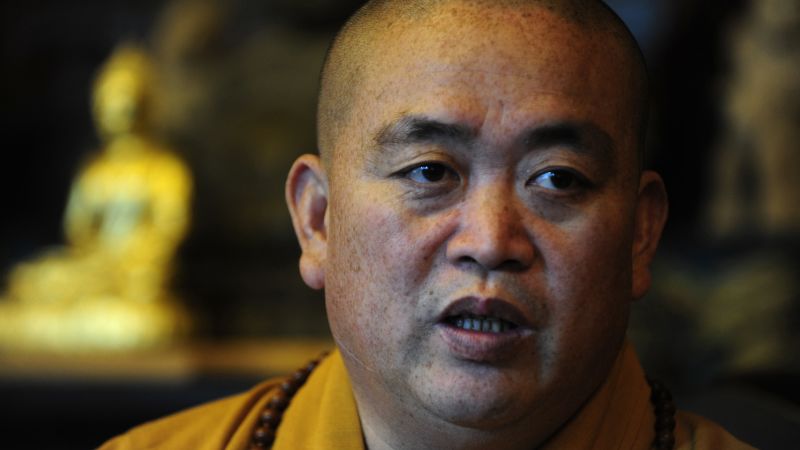
The arrest of Shi Yongxin, the abbot of China’s famed Shaolin Temple, on July 25, 2025, has sent shockwaves through China’s religious and cultural landscape. Known as the “CEO Monk” for his entrepreneurial transformation of the 1,500-year-old monastery into a global brand, Shi faces allegations of embezzlement, misappropriation of temple funds, and violating Buddhist precepts through “improper relationships” with multiple women and fathering at least one child. These charges, coupled with the revocation of his ordination certificate by the Buddhist Association of China, have reignited debates about the intersection of Buddhism, commerce, and politics in China. This article examines whether Shi’s case exposes Buddhism as a political syndicate controlled by the Chinese Communist Party (CCP), exploring the allegations, the role of state oversight, and the broader implications for religious institutions in China.
Shi Yongxin and the Shaolin Empire
Shi Yongxin, born Liu Yingcheng in 1965, became the abbot of the Shaolin Temple in Henan province in 1999 after joining the monastery in 1981. Under his leadership, the temple, established in AD 495 as a cradle of Zen Buddhism and Shaolin kung fu, evolved from a dilapidated religious site into a multimillion-dollar enterprise. Shi, the first Chinese abbot with a Master of Business Administration degree, leveraged the temple’s cultural cachet to establish dozens of companies worldwide, licensing the Shaolin brand for products like bottled water, video games, and kung fu performances. His initiatives included opening schools abroad, forming a traveling troupe of kung fu monks, and launching an online store selling merchandise like T-shirts and a kung fu manual priced at 9,999 yuan ($1,395).
Shi’s global outreach was equally high-profile. He met world leaders like Queen Elizabeth II, Nelson Mandela, and Pope Francis, and industry figures like Apple CEO Tim Cook, projecting Shaolin as a cultural ambassador for China. His role as a deputy in the National People’s Congress (NPC) from 1998 to 2018 and vice-chairman of the Buddhist Association of China since 2002 further cemented his political influence. However, his commercialization of Buddhism drew criticism for eroding spiritual integrity, earning him the moniker “CEO Monk” and accusations of turning the temple into a tourist-driven commercial empire.
The Allegations Against Shi Yongxin
On July 28, 2025, the Shaolin Temple announced that Shi was under investigation by multiple agencies for suspected criminal offenses, including:
-
Embezzlement and Misappropriation: Shi is accused of misusing temple funds and assets, with 17 associated companies under audit for financial mismanagement.
-
Violation of Buddhist Precepts: Allegations include maintaining “improper relationships” with multiple women over a long period and fathering at least one illegitimate child, breaching the Buddhist vow of celibacy.
-
Past Controversies: Similar accusations surfaced in 2015, including claims of fraud, sexual misconduct, and fathering children, supported by documents like a birth certificate allegedly linked to Shi. Provincial investigations cleared him in 2016, dismissing the claims as “vicious libel.”
The Buddhist Association of China, overseen by the CCP, revoked Shi’s ordination certificate, condemning his actions as “extremely egregious” and damaging to Buddhism’s reputation. Social media reactions on Weibo, where the scandal garnered over 560 million views, reflect public outrage, with some labeling Shi a “fallen monk” who exploited his position for personal gain.
Buddhism as a Political Syndicate?
The question of whether Buddhism in China functions as a political syndicate hinges on the CCP’s control over religious institutions. China’s religious policy mandates that all religious groups register with state-approved bodies, such as the Buddhist Association of China, which oversees doctrine, ordinations, and finances to ensure alignment with socialist principles. This system, rooted in the CCP’s “religion serves socialism” doctrine, aims to prevent political dissent and foreign influence but creates opportunities for corruption and political manipulation. Shi Yongxin’s case highlights this dynamic in several ways:
State Control and Political Influence
Shi’s tenure as a NPC deputy and his role in the Buddhist Association suggest deep ties to the CCP. His ability to expand the Shaolin brand with minimal oversight until 2025 indicates that his political connections may have shielded him from earlier scrutiny. The CCP’s swift action to defrock and investigate Shi, however, signals that his misconduct became too public to ignore, especially after trending on Weibo. Critics argue that the state’s control over religious appointments fosters a “political Buddhism” where monks prioritize political loyalty and commercial gain over spiritual duties, resembling a syndicate that serves CCP interests.
Commercialization and Corruption
Shi’s transformation of the Shaolin Temple into a commercial powerhouse aligns with the CCP’s promotion of cultural heritage for economic and soft power gains. His ventures, including a proposed $297 million hotel complex in Australia in 2015, reflect state-sanctioned commercialization. However, the lack of transparency in temple finances, a common issue in state-regulated religious institutions, enabled allegations of embezzlement. The 2017 clearance of similar charges suggests that Shi’s political clout may have previously protected him, raising questions about whether the Buddhist Association functions as a tool for political control rather than spiritual oversight.
Public Perception and Ideological Tension
Public discourse on Weibo reveals a split: some condemn Shi’s personal gain, while others see his case as evidence of systemic flaws in “political Buddhism.” The tolerance for monks’ personal indiscretions, such as relationships or meat consumption, contrasts with the harsher backlash against financial corruption, reflecting cultural nuances in Chinese Buddhism where martial arts monks are seen as less bound by traditional precepts. Yet, the CCP’s narrative frames Shi’s downfall as a crackdown on corruption, reinforcing its authority over religious institutions while deflecting scrutiny from systemic issues.
Broader Context: Scandals in Buddhist Institutions
Shi Yongxin’s case is not isolated. In 2018, Xuecheng, another high-profile monk and head of the Buddhist Association of China, faced allegations of sexual harassment and corruption at Beijing’s Longquan Temple. In Thailand, a 2025 scandal involving a woman blackmailing senior monks for sexual relationships led to the defrocking of nine abbots, prompting calls for tighter financial transparency in temples. These cases highlight a pattern where state oversight and commercial pressures blur the lines between spirituality and politics, enabling misconduct under the guise of religious authority.
In China, the CCP’s control over Buddhism ensures that religious leaders like Shi serve as both spiritual and political figures. The Buddhist Association’s role in vetting monks and approving ordinations creates a hierarchy where loyalty to the state often trumps doctrinal purity. This structure can foster a syndicate-like environment where religious institutions prioritize political alignment and profit over spiritual integrity, as seen in Shi’s global branding efforts and alleged financial mismanagement.
Critical Analysis: Syndicate or Symptom?
While the term “political syndicate” implies a deliberate, organized conspiracy, Shi’s case is better understood as a symptom of China’s state-controlled religious system. The CCP’s oversight, intended to align religion with socialist goals, creates a paradox: it promotes cultural heritage (e.g., Shaolin kung fu) for economic and diplomatic purposes but stifles spiritual autonomy, enabling figures like Shi to exploit their positions. The lack of independent oversight in temple finances and the political influence of figures like Shi suggest systemic vulnerabilities rather than a cohesive syndicate.
However, the rapid response to Shi’s scandal—his defrocking and the audit of 17 companies—indicates the CCP’s sensitivity to public backlash and its need to maintain legitimacy. Unlike a syndicate that protects its members, the CCP’s willingness to sacrifice Shi suggests that individual actors are expendable when their actions threaten the state’s narrative of control and moral authority. The 2016 exoneration of Shi contrasts with his 2025 downfall, hinting that political utility, rather than a syndicate, determines outcomes.
Implications for Chinese Buddhism
Shi Yongxin’s fall could reshape China’s Buddhist establishment. The scandal undermines the credibility of the Buddhist Association of China, raising questions about its ability to regulate without political bias. It may prompt stricter financial oversight of temples, as seen in Thailand’s response to its 2025 scandal. However, increased state control risks further eroding spiritual independence, potentially alienating devout Buddhists while reinforcing the perception of Buddhism as a state-managed enterprise.
For the Shaolin Temple, the scandal threatens its global brand and tourism revenue, which relies heavily on its spiritual and cultural allure. The CCP’s emphasis on “rule of law on religious work” suggests a broader crackdown on misconduct, but it may also intensify ideological alignment, limiting Buddhism’s role as a spiritual refuge.
Shi Yongxin’s arrest for embezzlement and misconduct does not conclusively prove that Chinese Buddhism is a political syndicate, but it exposes deep tensions between faith, commerce, and state control. His transformation of the Shaolin Temple into a global brand, enabled by CCP support, highlights how religious institutions can serve political and economic agendas. However, the systemic issues—lack of financial transparency, political oversight of ordinations, and the prioritization of socialist alignment—suggest that Buddhism in China operates within a tightly controlled framework that can enable corruption. Shi’s case is less about a coordinated syndicate and more about the vulnerabilities of a state-regulated religious system where power, politics, and profit often overshadow spirituality. As China navigates this scandal, the challenge lies in balancing cultural heritage with genuine religious autonomy, lest Buddhism becomes merely a tool of the state.
Comments are closed.