
China Reaffirms Goal to Land Astronauts on the Moon by 2030, Unveils New Space Station Crew

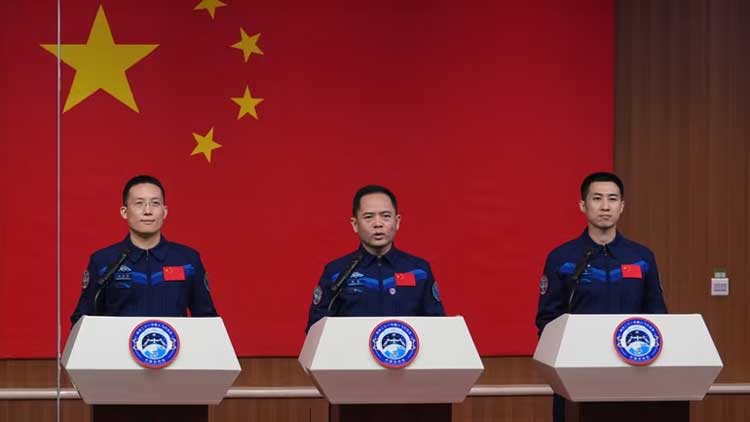
China on Thursday reaffirmed its plans to send astronauts to the moon by 2030, unveiling its next team of astronauts bound for the Tiangong space station — a key step in its broader ambition to become a global leader in space exploration.
“Each stage of our crewed lunar mission program is progressing smoothly,” said Zhang Jingbo, spokesperson for the China Manned Space Program, highlighting progress on the Long March 10 rocket, lunar landing suits, and exploration vehicles. “Our goal of landing a Chinese astronaut on the moon by 2030 is firm,” he added.
As part of its continuous space operations, China is preparing to launch a new rotation of astronauts to the Tiangong (“Heavenly Palace”) space station, where each crew stays for about six months conducting scientific experiments and maintenance tasks.
The newly announced Shenzhou 18 crew includes Zhang Lu, Wu Fei, and Zhang Hongzhang. The trio is scheduled to lift off from the Jiuquan Satellite Launch Center on Friday at 11:44 p.m. (local time). Zhang Lu previously served on the Shenzhou 15 mission, while for Wu and Zhang Hongzhang, this marks their first journey into space.
In a unique twist, the crew will also carry four mice — two male and two female — to study how weightlessness and confinement affect biological and behavioral responses.
China began building the Tiangong space station after being barred from participating in the International Space Station (ISS) due to U.S. national security concerns, given the Chinese space program’s links to the People’s Liberation Army.
With its expanding lunar program and an operational space station, Beijing is signaling that it intends not only to catch up with the U.S. and its partners in space exploration — but to compete head-to-head in the next great race beyond Earth.
Comments are closed.