
China Pushes Back Against US Pressure to Halt Russian and Iranian Oil Imports

Despite growing optimism over a potential US-China trade deal, a sharp divide remains over Washington’s demand that Beijing halt oil purchases from Iran and Russia. While both sides recently signaled progress in trade talks held in Stockholm, China has flatly rejected American pressure linking energy policy to trade concessions.
“China will always ensure its energy supply in ways that serve our national interests,” the Chinese Foreign Ministry posted on X following two days of negotiations. Responding to US threats of a 100% tariff on Chinese imports, the ministry added: “Coercion and pressuring will not achieve anything. China will firmly defend its sovereignty, security, and development interests.”
The firm stance highlights China’s strategic confidence, even as the world’s two largest economies attempt to de-escalate trade tensions that had previously spiraled into tit-for-tat tariffs.
US Treasury Secretary Scott Bessent acknowledged China’s strong position, stating, “The Chinese take their sovereignty very seriously,” after exiting the Stockholm talks. “We don’t want to impede on their sovereignty, so they would like to pay a 100 percent tariff,” he quipped. Still, Bessent said negotiations remain on track: “I believe that we have the makings of a deal.”
Experts are skeptical the US will follow through on such sweeping tariffs. “Realizing those threats would derail all the recent progress and probably kill any chance of a Trump-Xi deal this fall,” said Gabriel Wildau of consultancy Teneo.
The US has tied its tariff threats to geopolitical concerns — namely, cutting off a major revenue stream for Russia and Iran, both under sanctions. China, however, sees oil imports as a non-negotiable issue of national security and strategic independence.
China’s Energy Strategy
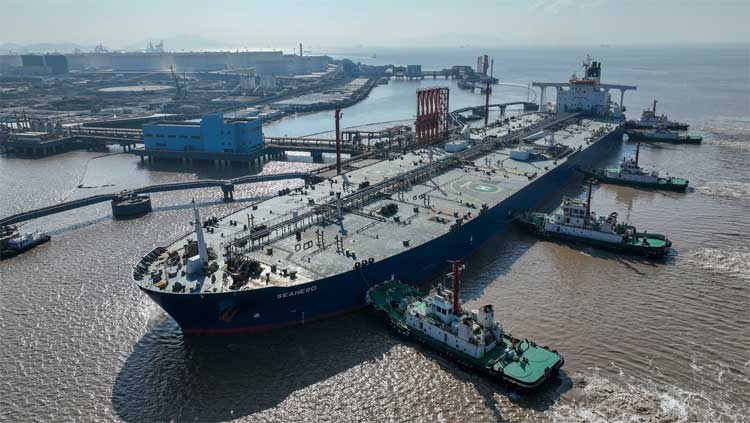
Data from the US Energy Information Administration shows that China accounts for 80–90% of Iran’s oil exports, importing over 1 million barrels daily. China is also a leading buyer of Russian crude — second only to India. Chinese imports of Russian oil spiked 20% in April, surpassing 1.3 million barrels per day.
Beijing’s energy calculus is both economic and political. Oil from Iran and Russia is cheaper due to global sanctions, and continuing those purchases supports China’s “strategic solidarity” with Moscow, said Danny Russel of the Asia Society Policy Institute. “Beijing simply can’t afford to walk away from oil from Russia and Iran. It’s too important a strategic energy supply — and Beijing is buying it at fire-sale prices.”
Scott Kennedy of the Center for Strategic and International Studies noted that China is unlikely to yield to US demands when it perceives inconsistency in Washington’s approach. “China’s support for Russia is consistent and clear,” he said, unlike US policy, which often wavers depending on political cycles.
Political Pressure in Washington
On Capitol Hill, lawmakers are intensifying calls for sanctions. Republican Sen. Lindsey Graham is leading a bipartisan push for legislation that would authorize tariffs as high as 500% on any country — including China and India — that buys oil or petrochemical products from Russia.
Graham said the goal is to stop nations from “empowering [Putin’s] war machine to kill innocent Ukrainian civilians.” The Senate bill has drawn support from 84 senators, with a matching House version also gaining traction.
The Trump administration has already announced a 25% tariff on Indian goods, citing its continued oil trade with Russia. India has defended its ties with Moscow as “steady and time-tested,” with its foreign ministry pushing back against the pressure.
White House adviser Stephen Miller reinforced the administration’s position. “It is not acceptable for India to continue financing the Ukraine war by purchasing oil from Russia,” he said, adding that the US must “get real” about cutting off Russian revenue streams.
Deal Still Possible?
Despite the high-stakes standoff over energy, negotiators from both countries insist a broader trade agreement is within reach. China may be using its energy independence as leverage to extract concessions elsewhere. Trump, meanwhile, is eager for a “headline-grabbing deal” with Xi — even if that means backing off certain demands.
As Russel put it: “Rejecting a US demand to stop buying oil from Iran or Russia is probably not seen [by Beijing] as a deal-breaker, even if it generates friction and delay.”
Comments are closed.