
China Launches Shenzhou-24 Carrying Pakistani Astronaut Muhammad Zeeshan Ali in Historic First Foreign Crew Mission

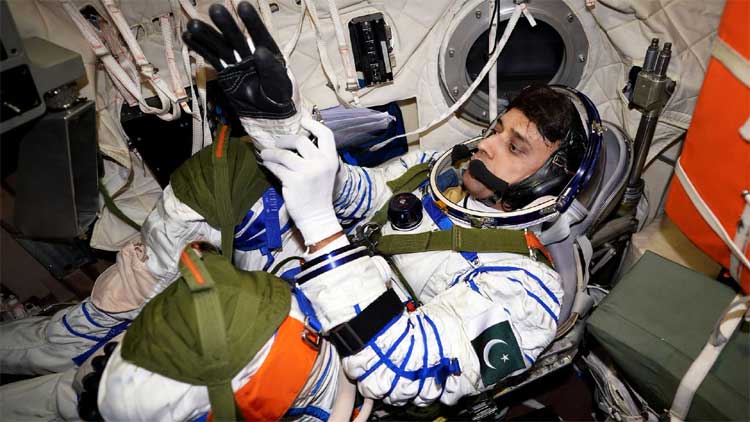
China on Wednesday successfully launched its Shenzhou-24 spacecraft carrying Pakistani astronaut Muhammad Zeeshan Ali, marking a historic milestone in the country’s human spaceflight programme. Ali has become the first foreign astronaut to travel as a crew member to China’s Tiangong space station.
The spacecraft was launched aboard a Long March-2F rocket from the Jiuquan Satellite Launch Center in the Gobi Desert region of northwestern China. It successfully entered its planned orbit, with the Beijing Aerospace Control Centre declaring the launch a “complete success”.
The 40-year-old Pakistani astronaut is travelling alongside two Chinese astronauts: mission commander Tang Hongbo, 51, and flight engineer Wu Yi, 39. The mission represents the first joint flight involving Chinese and foreign astronauts under China’s crewed space programme.
Following the successful launch, Chinese President Xi Jinping highlighted the country’s long-term ambitions in space exploration.
“To explore the vast cosmos, develop the space industry and build China into a space power is our eternal dream,” Xi said, according to the BBC.
Pakistan Celebrates Historic Space Mission
The launch generated considerable excitement in Pakistan, where people watched the event on television and gathered to celebrate the country’s growing role in international space exploration.
Scientists at Pakistan’s space agency also followed the launch, while crowds had earlier attended a farewell ceremony at the launch centre, the Associated Press reported.
Pakistan’s Planning Minister Ahsan Iqbal, who was present at the launch site, expressed gratitude to Chinese President Xi Jinping and the country’s leadership, scientists and engineers for making the mission possible.
He also expressed hope that the historic flight would pave the way for deeper cooperation between Pakistan and China in space research and technology.
Ali, who is serving as a payload specialist, will participate in scientific experiments during his approximately week-long stay aboard the Tiangong space station. He is scheduled to return to Earth aboard the Shenzhou-23 spacecraft.
China-Pakistan Space Cooperation Agreement
The mission is part of a bilateral space cooperation agreement signed between China and Pakistan in February 2025.
The partnership reflects Beijing’s efforts to expand international participation in its space programme while strengthening scientific and technological cooperation with Islamabad.
For Tang Hongbo, the mission marks another major achievement. Having previously travelled to space twice, he is expected to become the first astronaut to visit China’s Tiangong space station on three separate occasions.
Meanwhile, the flight marks the first space journey for both Pakistani astronaut Ali and Chinese flight engineer Wu Yi.
Speaking before the launch, Tang said the crew had worked hard to overcome challenges involving language and cultural differences during their preparations.
Ali also demonstrated his Mandarin-speaking skills during a pre-launch news conference, reciting a Chinese poem about climbing higher to gain a broader view.
The Pakistani astronaut said he hoped the partnership would eventually expand beyond sending one astronaut on a single mission to conducting more joint space flights, potentially including future missions to the Moon and Mars.
What Will the Shenzhou-24 Crew Do in Space?
The Shenzhou-24 crew is scheduled to conduct more than 90 scientific experiments and technological tests during the mission.
The research programme will cover several areas, including space life sciences, aerospace medicine and combustion science. One of the key studies will investigate how the space environment affects vascular ageing, potentially providing insights into the prevention and treatment of related health conditions.
Ali will focus on experiments involving photosynthesis in bacteria and examine how microgravity and space radiation influence quinoa seeds.
These studies are expected to provide valuable information about biological processes in space and their potential applications in future long-duration missions.
After spending approximately one week aboard Tiangong, Ali is expected to return to Earth, while Tang and Wu will continue their mission.
Chinese Astronauts to Spend Six Months Aboard Tiangong
Following Ali’s departure, Tang and Wu are scheduled to remain aboard the Chinese space station for approximately six months.
They will work alongside Zhu Yangzhu, a member of the Shenzhou-23 crew who has been studying how the human body adapts to extended periods in space.
The extended mission will allow Chinese researchers to conduct further experiments and evaluate technologies required for long-duration human spaceflight.
The successful launch of Shenzhou-24 represents an important step in China’s ambitions to expand its presence in space. It also opens a new chapter in China-Pakistan cooperation, potentially creating opportunities for more international participation in future space exploration programmes.
Comments are closed, but trackbacks and pingbacks are open.