
Chandrayaan-2 Observes Sun’s Coronal Mass Ejection Impact on Moon for the First Time

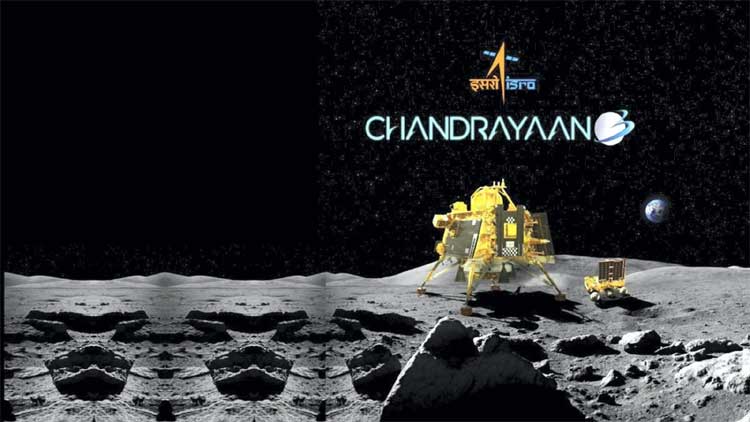
India’s Chandrayaan-2 lunar orbiter has, for the first time, directly observed the effects of a solar Coronal Mass Ejection (CME) on the Moon, using its scientific instrument, Chandra’s Atmospheric Composition Explorer-2 (CHACE-2).
Data from CHACE-2 revealed a significant increase in the total pressure of the dayside lunar exosphere — the Moon’s extremely thin atmosphere — when the CME struck. The number density of neutral atoms and molecules rose by more than an order of magnitude, confirming predictions from earlier theoretical models but now observed for the first time in reality, according to an official statement.
Unlike Earth, the Moon has a fragile surface-bound exosphere, where gas particles rarely interact and originate from processes such as solar radiation, solar wind, and meteorite impacts. CMEs, which eject large amounts of Helium and Hydrogen ions from the Sun, significantly affect the lunar exosphere because the Moon lacks a global magnetic field to shield it.
The observation was made possible during a rare series of CMEs on May 10, 2024. The increased influx of solar material struck the lunar surface, liberating atoms into the exosphere and temporarily raising its total pressure on the sunlit side of the Moon.
Scientists say this finding enhances understanding of lunar exosphere dynamics and space weather effects on the Moon. It also underscores the challenges of establishing scientific bases on the Moon, as temporary changes in the lunar environment during extreme solar events must be considered in the design and operation of lunar habitats.
Comments are closed.