
Ceasefire, $350 Billion Trade Deal & Nobel Nods: Key Takeaways from Trump’s Asia Tour

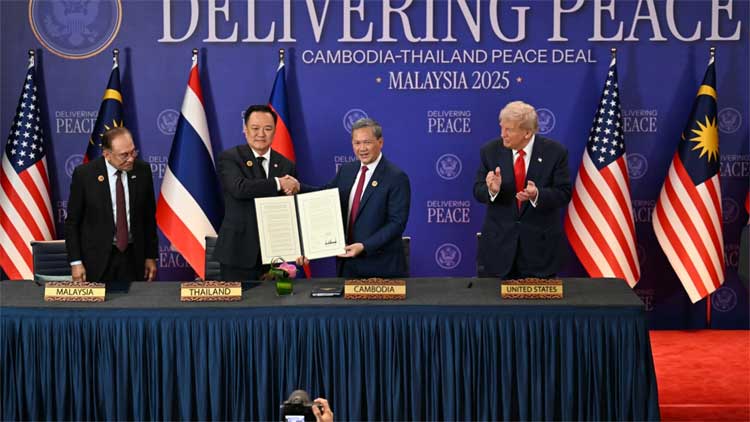
US President Donald Trump on Thursday wrapped up his five-day Asia tour — a whirlwind of diplomacy, trade negotiations, and peace talks — that spanned Malaysia, Japan, and South Korea. The visit combined landmark deals, a regional ceasefire, and two Nobel Peace Prize nominations, underscoring Trump’s effort to project himself as both a peacemaker and dealmaker in a reshaped Asian landscape.
Ceasefire Between Thailand and Cambodia
A major highlight of the tour was the Thailand–Cambodia ceasefire, signed in Trump’s presence after brief but deadly border clashes in July. The US-brokered agreement aims to end hostilities and establish long-term stability in Southeast Asia.
Calling it a “momentous day for all the people of Southeast Asia,” Trump co-signed the pact alongside the leaders of Thailand and Cambodia, reaffirming the US’s regional influence in peace diplomacy.
Trade and Mineral Agreements
Trump’s tour began in Malaysia, where he signed multiple trade and resource deals, including two memoranda of understanding to boost cooperation on critical minerals with Malaysia and Thailand.
Malaysia agreed to expand US access to its rare mineral resources, while both nations pledged accelerated development of the industry in partnership with American firms.
With Japan, the US finalized key frameworks on rare-earth collaboration, tariff reductions, and mutual investments, strengthening efforts to diversify supply chains away from China.
In South Korea, Trump secured one of the largest trade and investment packages of his presidency — a US$350 billion agreement spanning semiconductors, EV components, and industrial materials. Both countries agreed to reduce tariffs from 25% to 15%. Seoul will also invest $350 billion in the US, including $200 billion in direct investments and $150 billion in shipbuilding initiatives.
Trump–Xi Meeting in Busan
The tour concluded with a highly anticipated meeting between Trump and Chinese President Xi Jinping in Busan — their first face-to-face interaction since 2019.
The leaders agreed to a tariff reduction on Chinese goods — from 57% to 47% — in exchange for Beijing’s renewed efforts to curb the fentanyl trade, resume U.S. soybean imports, and maintain rare earth exports.
Two Nobel Peace Prize Nominations
During the tour, Trump received two new nominations for the Nobel Peace Prize — from Japan’s Prime Minister Sanae Takaichi and Cambodia’s Hun Manet — recognizing his role in mediating international conflicts.
While Trump did not win the prize this year, his nomination list now includes Israel, Pakistan, Cambodia, Thailand, and Japan, boosting his campaign to rebrand his presidency on the global stage.
The trip, filled with symbolic gestures and high-stakes negotiations, marked Trump’s most ambitious attempt yet to reshape his foreign policy legacy in Asia ahead of the 2026 U.S. elections.
Comments are closed.