
Canada, France Open Consulates in Greenland, Signal Support Amid Trump Pressure

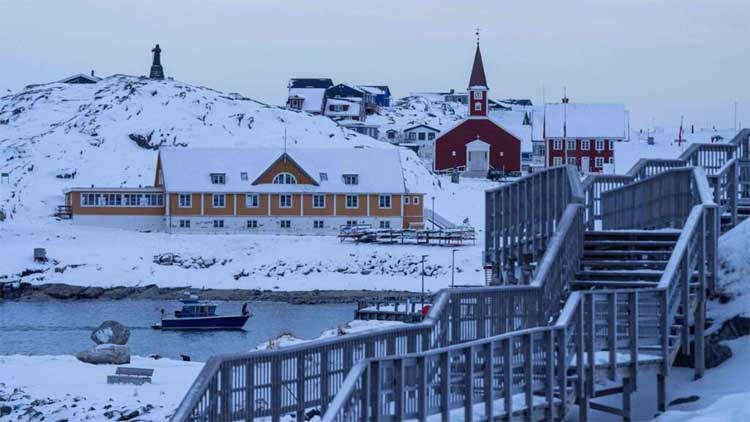
Canada and France will open new consulates in Greenland’s capital, Nuuk, on Friday, in a strong show of support for the Danish autonomous territory amid renewed pressure from former US President Donald Trump.
Both countries have firmly opposed Trump’s long-standing ambition to bring Greenland under US control. Since returning to the White House last year, Trump has repeatedly argued that Washington needs control of the strategic, mineral-rich Arctic island for security reasons.
Last month, Trump appeared to soften his stance, saying he had reached a “framework” agreement with NATO Secretary General Mark Rutte to expand American influence in the region. A joint working group involving the US, Denmark and Greenland has since been formed to address Washington’s security concerns, though details of the talks remain undisclosed.
While Denmark and Greenland acknowledge the importance of Arctic security, they have insisted that sovereignty and territorial integrity are “red lines” in any negotiations.
“In a sense, it’s a victory for Greenlanders to see two allies opening diplomatic representations in Nuuk,” said Jeppe Strandsbjerg, a political scientist at the University of Greenland. “There is great appreciation for the support against what Trump has said.”
French President Emmanuel Macron announced Paris’s decision to open a consulate during a visit to Nuuk in June, when he expressed Europe’s “solidarity” with Greenland and criticised Trump’s ambitions. The newly appointed French consul, Jean-Noel Poirier, previously served as France’s ambassador to Vietnam.
Canada had announced in late 2024 that it would open a consulate in Greenland to strengthen cooperation in the Arctic.
According to Ulrik Pram Gad, an Arctic expert at the Danish Institute of International Studies, the move sends a clear message to Washington.
“It’s a way of telling Donald Trump that his aggression against Greenland and Denmark is not a question for them alone. It concerns European allies and Canada as well,” he told AFP.
Christine Nissen, a security and defence analyst at the Europa think tank, said the decision reflects a broader European strategy.
“It’s a small step in making this problem European,” she said. “The consequences are not just Danish. They are European and global.”
Recognition of Growing Autonomy
The two new consulates, which will be attached to the French and Canadian embassies in Copenhagen, are also seen as recognition of Greenland’s increasing autonomy.
Strandsbjerg said the presence of foreign diplomatic missions would allow Greenland to “practice” operating independently, as the island has long aspired to loosen its ties with Denmark.
The move reflects Greenland’s growing self-rule under its 2009 Self-Government Act, Nissen noted.
“In terms of their quest for sovereignty, Greenlanders will welcome more direct contact with other European countries,” she said.
Pram Gad added that expanding diplomatic ties could reduce Greenland’s dependence on Denmark by diversifying its international relationships.
“This allows Greenland to build broader links for its economy, trade, investment and politics,” he said.
Greenland has maintained diplomatic relations with the European Union since 1992, with the United States since 2014, and with Iceland since 2017. Iceland opened a consulate in Nuuk in 2013, while the US reopened its mission in the capital in 2020 after closing it in 1953. The European Commission also established an office in Nuuk in 2024.
Comments are closed.