
Bush Viewed Iraq War as ‘Crusade’, UK Records Reveal; Diplomats Warned of Fallout Without UN Backing

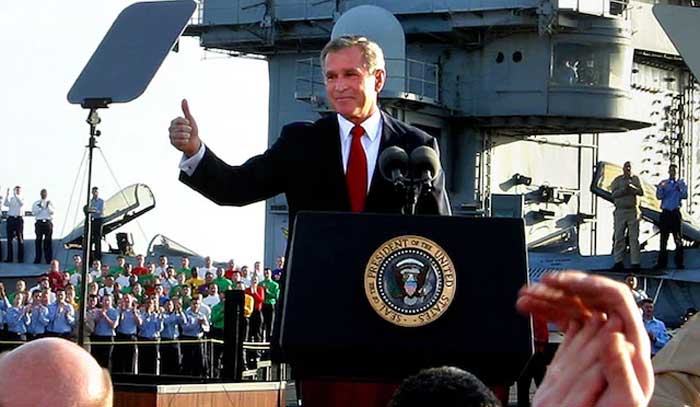
Newly declassified UK government documents have revealed that former US President George W. Bush saw the Iraq war as a spiritual mission, describing it as a “crusade” to eliminate global “evil-doers,” including Saddam Hussein. The records, released on Tuesday, offer a candid view of how British officials viewed Washington’s motives and strategy in the run-up to the 2003 invasion.
According to a diplomatic cable dated December 2002, Sir Christopher Meyer, then the UK’s ambassador to Washington, reported that Bush believed the US was “God’s chosen nation” with a divine duty to lead a moral struggle. “His view of the world is Manichean,” Meyer wrote, adding that Bush saw it as his mission to rid the world of evil. The president reportedly dismissed European leaders’ distinctions between Osama bin Laden and Saddam Hussein as “self-serving.”
Meyer noted Bush’s deep fear of another terror attack on US soil, especially one tied to Iraq, and described his worldview as one shaped by his Southern religious roots. “Anyone who has sat round a dinner table with low-church Southerners will find these sentiments instantly recognisable,” he said.
In January 2003, then-Prime Minister Tony Blair met Bush to urge a diplomatic solution. However, a memo from January 29 quoted Meyer warning that Bush was politically committed to launching military action in Iraq unless Saddam surrendered or was removed.
A day later, Blair’s foreign policy adviser Sir David Manning cautioned that a second UN resolution was “politically essential for the UK, and almost certainly legally essential as well.” He warned Condoleezza Rice, Bush’s national security adviser, that bypassing the UN could collapse Blair’s Labour government. “The US must not promote regime change in Baghdad at the price of regime change in London,” he said.
Manning told Blair that Bush could afford to take political risks with or without a UN resolution, but “you would not.” Rice reportedly acknowledged the difference, comparing the situation to a poker game: “There comes a point… when you have to show your cards,” she said.
The trove of records also includes a personal birthday message from Russian President Vladimir Putin to Blair in 2001, praising their meeting in Stockholm and hoping for stronger UK-Russia ties.
Another revelation involved then-French President Jacques Chirac, who privately told Blair that International Development Secretary Clare Short was “viscerally anti-French and insupportable.” In an offbeat attempt to lighten tensions, British officials floated the idea of gifting Chirac a map of British military failures in Afghanistan as a birthday joke.
The documents offer a rare behind-the-scenes glimpse into the intense diplomatic maneuvering, ideological convictions, and personal dynamics that shaped one of the most consequential military decisions of the 21st century.
Comments are closed.