
BRICS Nations to Condemn Trump-Era Tariffs for Fueling Global Economic Uncertainty

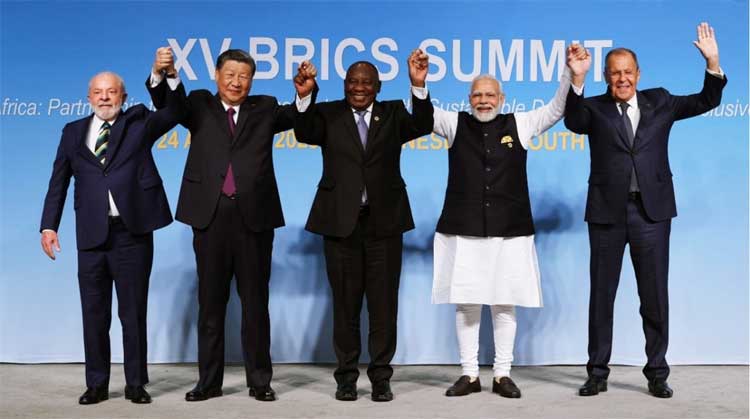
BRICS leaders meeting in Rio de Janeiro from Sunday are expected to jointly criticize U.S. trade protectionism, but remain divided over how to address escalating conflicts in the Middle East.
Representing nearly half of the world’s population and around 40% of global economic output, the bloc — which includes Brazil, Russia, India, China, and South Africa — is reportedly preparing a statement condemning the economic uncertainty caused by what they view as unfair U.S. import tariffs.
Since taking office in January, U.S. President Donald Trump has imposed a series of punitive trade measures on both allies and rivals. His latest round of tariff hikes is set to be formally announced in letters to trading partners starting Friday, with implementation expected by July 9.
Diplomats from 11 emerging economies — including recent BRICS invitees such as Iran, the UAE, Egypt, Ethiopia, and Indonesia — have been working to finalize a declaration addressing global trade volatility. While the document is unlikely to name the U.S. or Trump directly, sources familiar with the drafting say the message will unmistakably target Washington’s approach.
“We’re anticipating a summit with a cautious tone. It will be difficult to mention the United States by name in the final declaration,” said Marta Fernandez, director of the BRICS Policy Center at Rio’s Pontifical Catholic University. “This is especially true for China, which has recently struck a deal with the U.S. to ease mutual tariffs. This doesn’t seem the right time to provoke further friction.”
Xi’s Absence a Setback for Host Brazil
The summit’s impact is expected to be somewhat muted by the absence of Chinese President Xi Jinping, who is skipping the annual meeting for the first time in his 12 years in power. The Chinese delegation will instead be led by Premier Li Qiang.
“I expect there will be speculation about Xi’s reasons,” said Ryan Hass, a former China director at the U.S. National Security Council, now at the Brookings Institution. “The simplest explanation may be the right one — Xi recently hosted President Lula in Beijing.”
Another possible factor: Russian President Vladimir Putin, under indictment for war crimes, will attend only via video link, while Indian Prime Minister Narendra Modi is set to be the guest of honor in Brazil and will receive a state lunch. “Xi may not want to appear upstaged by Modi,” Hass noted.
Xi’s absence is a blow to Brazilian President Luiz Inácio Lula da Silva, who has been seeking a more prominent role for Brazil on the global stage. In the run-up to the 2026 elections, Brazil will host the G20, the BRICS summit, and COP30 climate talks, all key events in Lula’s diplomatic push.
Middle East Conflicts Divide the Bloc
While BRICS is united on trade, sharp disagreements remain over responses to global conflicts — particularly the wars in Gaza and between Iran and Israel.
Iran’s new president, Masoud Pezeshkian, is also skipping the summit, amid tensions following a 12-day conflict with Israel. Sources say Tehran has been lobbying for the group to adopt a stronger stance on the Middle East, beyond general calls for peaceful resolution and a two-state solution.
But the grouping has not yet reached consensus, with positions varying widely among members.
Artificial intelligence and global health will also feature on the summit agenda, as BRICS continues expanding its focus beyond economics and trade.
Once a coalition of four fast-growing economies, BRICS has grown more diverse — and more unwieldy — with the recent inclusion of several additional nations. While this expansion has increased its global weight, it has also introduced new internal tensions.
Still, Brazil remains hopeful for unity. “BRICS has historically managed to speak with one voice on major international issues,” said Brazilian Foreign Minister Mauro Vieira. “There’s no reason that shouldn’t be the case this time, even on the Middle East.”
Comments are closed.