
Brazilian Police Raid Bolsonaro’s Home as Court Imposes Strict Measures in Coup Trial

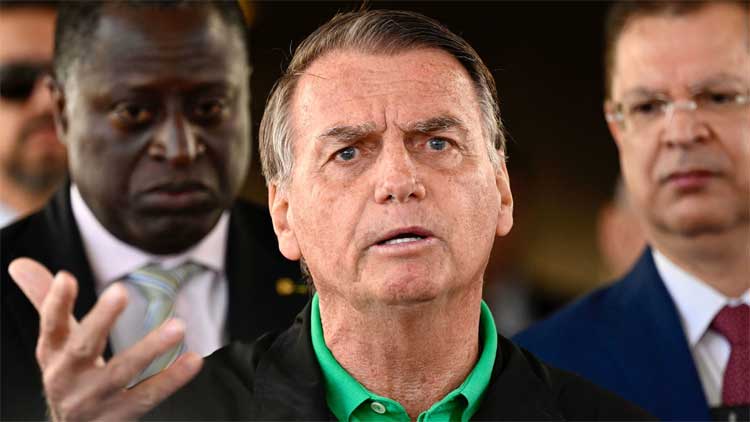
Brazilian police raided the home of former President Jair Bolsonaro on Friday as the far-right leader faces mounting legal pressure in a coup plot trial that has drawn international attention—and vocal support from U.S. ally Donald Trump.
The raid came as Supreme Court Justice Alexandre de Moraes ordered Bolsonaro to wear an electronic ankle monitor, banned him from using social media, and confined him to his home during nights and weekends. The judge also barred Bolsonaro from visiting foreign embassies, citing “hostile acts” carried out by both Bolsonaro and his son, Congressman Eduardo Bolsonaro.
Eduardo, who recently relocated to the United States to lobby on his father’s behalf, confirmed the raid in a post on X (formerly Twitter), denouncing Moraes as a “political gangster in robes” and accusing him of weaponizing the court against Bolsonaro and even the U.S. government. In a fiery open letter, Eduardo called himself a “Brazilian congressman in exile” and claimed the judge was trying to criminalize former President Trump.
Trump, who has repeatedly backed Bolsonaro, responded by slapping a 50% tariff on Brazilian exports, calling the legal actions against Bolsonaro a “witch hunt.” The Biden administration, meanwhile, took a dramatically different approach: Secretary of State Marco Rubio announced the U.S. was revoking Moraes’ visa and imposing travel restrictions on other judges aligned with him, citing “political persecution.”
The Brazilian government, under President Luiz Inácio Lula da Silva, swiftly condemned the U.S. tariffs as “unacceptable blackmail” and vowed to resist any attempts at interference.
Bolsonaro, 70, described the court-imposed restrictions as a “supreme humiliation.” Speaking to reporters after being taken to the Justice Ministry following the raid—during which police reportedly seized cash—he denied trying to flee or seek asylum.
“I never thought about leaving Brazil, I never thought about going to an embassy,” he said. His defense team issued a statement expressing “surprise and indignation” at the latest restrictions, which include a curfew between 7 p.m. and 6 a.m. on weekdays, and house arrest on weekends and holidays.
Prosecutors this week asked Brazil’s top court to convict Bolsonaro for “armed criminal association” and plotting to “violently overthrow the democratic order” following Lula’s narrow 2022 election win. They allege Bolsonaro sought to reverse the result through a failed coup plan that lacked military support. After the plan unraveled, Bolsonaro supporters—dubbed “Bolsonaristas”—stormed government buildings in early 2023, echoing the January 6, 2021 Capitol attack in Washington.
Like Trump, Bolsonaro has claimed he is a victim of political persecution. Both leaders have painted their legal troubles as efforts to silence populist movements.
If convicted, Bolsonaro and seven co-defendants could face up to 40 years in prison. A five-judge panel—including Moraes—will rule after Bolsonaro’s defense delivers its closing arguments.
Although Bolsonaro has voiced his intent to run again in next year’s presidential election, he is currently barred from holding office after a court found him guilty of spreading falsehoods about Brazil’s electoral system.
President Lula, 79, confirmed on Friday that he will seek a third term. “I will be a candidate again,” he declared at a public event in Ceará. “I will not hand this country over to that bunch of lunatics who almost destroyed it.”
Justice Moraes, a central figure in Brazil’s legal battles over misinformation and political extremism, has clashed frequently with Bolsonaro allies. Last year, he suspended Elon Musk’s social media platform X in Brazil for 40 days over its failure to remove disinformation—much of it traced to Bolsonaro supporters.
Comments are closed.