
Bonn Climate Talks Begin Amid Geopolitical Tensions, Climate Finance Deadlock, and Rising Global Temperatures

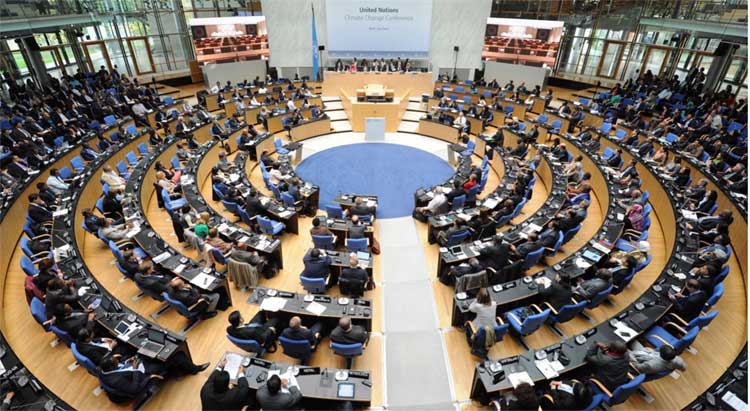
The Bonn Climate Change Conference (SB62) opens Monday and will run through June 26, serving as a critical midway point ahead of the COP30 climate summit in Belém, Brazil, this November. The negotiations come at a time of deepening global conflict, sharp divisions on climate finance, and a worsening climate emergency.
This year’s Bonn meeting is set against a backdrop of heightened geopolitical turmoil, including Israel’s ongoing strikes on Iran, and lingering frustrations over failed climate finance talks at COP29 in Baku. The road map from Baku to Belém, particularly the $1.3 trillion climate finance goal, remains fraught with disagreement.
Deep Divisions on Climate Finance and Equity
A recent analysis by the Centre for Science and Environment (CSE) highlights sharp differences among negotiating blocs:
-
The G77 and China have reiterated that any climate finance framework must be anchored in equity and the principle of Common but Differentiated Responsibilities (CBDR). They are demanding that developing nations retain the right to determine their own pathways for utilizing climate finance.
-
The Like-Minded Developing Countries (LMDC) group has pushed back against international taxes, levies, and debt-based approaches, warning they infringe on national sovereignty.
-
India, as HT reported on June 3, has cautioned that without sufficient climate finance, even its existing Nationally Determined Contributions (NDCs) will be unachievable, let alone any future enhancements. India emphasized that finance should flow from developed to developing countries, with public capital used to leverage private investment, and warned that excessive borrowing risks fiscal stability.
In an earlier interview with Hindustan Times, Union Environment Minister Bhupender Yadav reaffirmed India’s stance:
“India’s asks are as articulated in Article 4.7 of the UNFCCC — economic and social development and poverty eradication are the first and overriding priorities for developing countries… Climate action must align with our Viksit Bharat 2047 vision.”
The Arab Group has also raised objections to any attempt at reshaping finance obligations to shift more burden onto developing countries.
In contrast, the European Union has called for unlocking private capital through carbon pricing and innovative finance instruments. Canada has proposed removing barriers to private investment and enhancing financial “readiness” in developing economies. These diverging priorities underscore a deep divide.
US Withdrawal, Climate Legitimacy Crisis
Adding to the complexity, President Donald Trump’s withdrawal of the U.S. from the Paris Agreement via executive order earlier this year has weakened global momentum. The U.S., the largest historical emitter, has exited at a time when climate diplomacy is under acute pressure.
“We are facing a crisis of legitimacy and a breakdown of trust in the UN climate process,” said Tasneem Essop, Executive Director of Climate Action Network International (CAN). “Justice must not be a side conversation — it must be the foundation of COP30’s success.”
Climate Crisis Escalates
The urgency is underscored by alarming new data:
-
According to the World Weather Attribution group, climate change intensified Arctic heat by 3°C last month, causing Greenland’s ice sheet to melt 17 times faster than usual.
-
The planet has now experienced 21 consecutive months with global average temperatures above 1.5°C compared to pre-industrial levels.
-
The World Meteorological Organization (WMO) has warned of an 80% chance that 2025–2029 will contain a year hotter than 2024 and a 70% probability that the five-year average will breach the 1.5°C threshold — heightening risks of heatwaves, droughts, and extreme weather.
Critical Weeks for Climate Action
The next few weeks mark a pivotal moment for global climate governance. A trio of international events — the G7 Summit (June 15–17), SB62 in Bonn (June 16–26), and the UN Financing for Development Conference in Seville (June 30–July 3) — will test the international community’s resolve to confront both environmental and political crises.
“This is one of the few remaining spaces where countries still come together,” said Avantika Goswami, Programme Manager, Climate Change, CSE. “The Bonn conference must reinforce our commitment to cooperative, equitable climate action, despite the mounting global disorder.”
Climate activist Harjeet Singh, founding director of Satat Sampada Climate Foundation, warned:
“We’re in the middle of multiple escalating crises. The Bonn talks are not a side note — they are the foundation for COP30. Delaying action means deepening injustice and multiplying both human and ecological costs.”
Only 22 countries have submitted updated national climate plans (NDCs) due this year, and just one — the UK — is rated in line with the Paris Agreement’s 1.5°C goal. Major emitters like China and the EU have yet to announce their 2035 climate targets.
Comments are closed.