
BJP Sets Its Sights on Tamil Nadu: Mission 2026 Gains Momentum

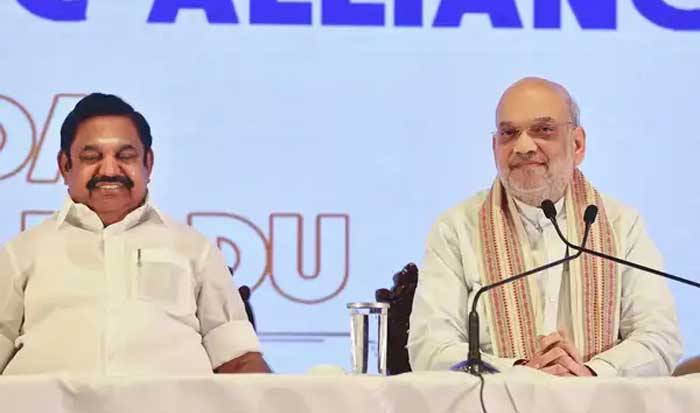
The rehearsals for the 2026 Tamil Nadu Assembly elections appear to have begun with Union Home Minister Amit Shah’s recent visit to the state. Ostensibly aimed at reviewing the Bharatiya Janata Party’s (BJP) preparedness and reinforcing its ties with allies, Shah’s visit also revealed a marked shift in tone and ambition.
The BJP, long a marginal player in Tamil Nadu politics, is now visibly gearing up for a more assertive role in the electoral landscape.
A Sharpened Attack on DMK
In a combative address, Shah launched a direct offensive against the ruling Dravida Munnetra Kazhagam (DMK), mirroring the rhetoric often used against Mamata Banerjee and the Trinamool Congress (TMC) in West Bengal. He confidently asserted that both TMC and DMK would be defeated in their respective states in the next assembly elections, declaring that the National Democratic Alliance (NDA), led by the BJP, would form the next government in Tamil Nadu.
While the political realities in Tamil Nadu and West Bengal differ significantly, BJP’s aggressive posture in the southern state cannot be ignored. However, the party must contend with deep-rooted complexities within the NDA alliance, which includes AIADMK, PMK, DMDK, Puthiya Tamizhagam (PT), and the BJP itself.
Alliance Troubles and Factional Faultlines
One of the key challenges for the BJP is managing its alliance with the AIADMK, especially in the face of ongoing factional struggles. The issues of leadership, seat-sharing, and coordination remain unresolved. Edappadi K. Palaniswami (EPS), the de facto leader of the AIADMK, has shown little interest in reconciling with former leaders O. Panneerselvam (OPS), V.K. Sasikala, or T.T.V. Dhinakaran—further complicating efforts to unify the party ahead of the elections.
Additionally, internal rifts within other allies, such as the father-son feud in PMK, and the strained relations between AIADMK and DMDK, add to the uncertainty. For the BJP, the challenge is not merely managing its own cadre but influencing and coordinating among fractured allies.
Parallel Strategy: Beyond AIADMK
Despite these alliance troubles, the BJP seems to be preparing for a two-pronged strategy: continuing negotiations with allies while simultaneously building an independent organisational base in Tamil Nadu. Shah’s meetings with BJP functionaries at the state, district, and mandal levels reflect this shift in focus.
This is the essence of “Mission Tamil Nadu”—an ambitious attempt to bypass traditional Dravidian politics by overtaking the AIADMK and positioning the BJP as the primary challenger to the DMK. EPS is aware of this strategic repositioning, but his weakened standing within his own party limits his options.
Playing the Religious Card
The BJP is also not shying away from deploying religious and cultural symbolism as part of its campaign. The upcoming Lord Murugan Devotees’ Conference and the politicisation of iconic temples like Madurai Meenakshi Amman are seen as attempts to mobilise Hindu voters and craft a north-centric narrative in Tamil Nadu’s political space.
This is akin to the party’s growing involvement in Durga Puja celebrations in West Bengal—a cultural outreach meant to expand BJP’s socio-religious appeal in regions where it has historically struggled.
From Confidence to Caution: Ground Realities Matter
Bolstered by recent gains in Odisha and Delhi, the BJP seems emboldened to challenge entrenched regional powers like the DMK. However, it must also reckon with the unique socio-political landscape of Tamil Nadu.
Unlike West Bengal, Tamil Nadu’s historical resistance to communal polarisation, coupled with deep-rooted Dravidian identity politics, may limit the efficacy of BJP’s religious rhetoric. Key issues such as the language debate, delimitation concerns, the Centre-state power balance, and the role of institutions like NITI Aayog, will play a critical role in shaping voter sentiments.
Conclusion
Amit Shah’s aggressive tone and BJP’s parallel strategy indicate a clear ambition: to redefine electoral politics in Tamil Nadu. But whether this approach will translate into tangible success remains uncertain. The BJP’s ability to navigate complex alliances, cultural dynamics, and regional sensitivities will determine how far “Mission Tamil Nadu” can go in reshaping the state’s political future in 2026.
Comments are closed.