
Bangladesh Election 2026 LIVE Updates: Voting Underway in High-Stakes Polls, Women Make Up Just 4.24% of Candidates

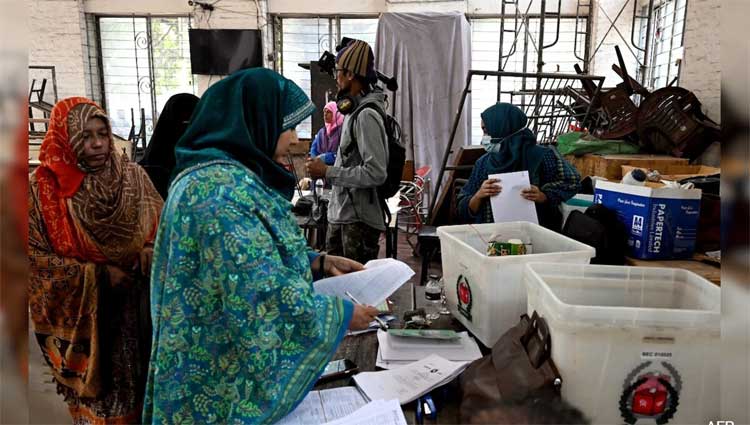
Voting has begun in Bangladesh’s national election, with polling underway from 7:30 am to 4:30 pm local time. The vote marks the country’s first election since the dramatic ouster of former prime minister Sheikh Hasina and the death of BNP leader Khaleda Zia, signalling a pivotal moment in the nation’s political landscape.
More than 127 million voters are eligible to cast ballots in the country of nearly 170 million people. A total of 1,981 candidates are contesting parliamentary seats nationwide. Despite over 2,000 candidates participating, only 109 are women, according to local media reports.
The election is widely viewed as Bangladesh’s most competitive contest in over a decade, particularly after the Election Commission cancelled the registration of Hasina’s Awami League, effectively barring it from the race. The polls are being conducted under an interim government led by Nobel Peace Prize laureate Muhammad Yunus, which has pledged to ensure a free, fair, and peaceful process.
Top contenders in the race
Bangladesh’s politics has long been shaped by the rivalry between Sheikh Hasina and Khaleda Zia. With the Awami League sidelined, the Bangladesh Nationalist Party (BNP) has emerged as the principal contender.
The BNP is fronted by Tarique Rahman, son of the late Khaleda Zia, who returned to Bangladesh in December after 17 years in exile. Rahman has campaigned on promises to strengthen democratic institutions, restore the rule of law, and revive the economy.
Challenging the BNP is an 11-party alliance led by the Islamist Jamaat-e-Islami, which has regained political space following Hasina’s removal. The bloc includes the newly formed National Citizen Party, launched by Gen Z student leaders associated with the 2024 uprising.
A Gen Z-influenced election
The election is being described by observers as Bangladesh’s first “Gen Z-inspired” vote. Young voters, who played a key role in last year’s protests, are expected to significantly shape the outcome. Analysts estimate that roughly a quarter of the electorate belongs to Generation Z.
Political experts say youth participation could prove decisive, particularly with nearly five million first-time voters casting ballots.
Hasina’s criticism from exile
From her exile in India, Sheikh Hasina has criticised the election process, warning of instability if it is not inclusive.
“A government born of exclusion cannot unite a divided nation,” Hasina said in remarks shared with international media, arguing that denying participation to major political forces risks undermining democratic legitimacy.
Key issues for voters
Several pressing concerns dominate the campaign:
-
Corruption: Consistently cited as the top voter concern in opinion surveys.
-
Inflation: Rising prices continue to strain household budgets.
-
Economic recovery: Growth has slowed since the pandemic disrupted key industries.
-
Employment: Job creation remains critical, especially for the large youth population.
-
Awami League’s absence: While some supporters may abstain, analysts believe their influence will persist.
Beyond the ballot
Alongside parliamentary voting, citizens will also decide on proposed political reforms through a referendum. The measures include potential limits on prime ministerial terms and enhanced checks on executive power.
The election is seen as a crucial test for Bangladesh’s democratic trajectory, with the results likely to determine whether recent political upheavals translate into lasting institutional change.
Comments are closed.