
Australian Open 2026: At 40, marathon man Stan Wawrinka keeps pushing on

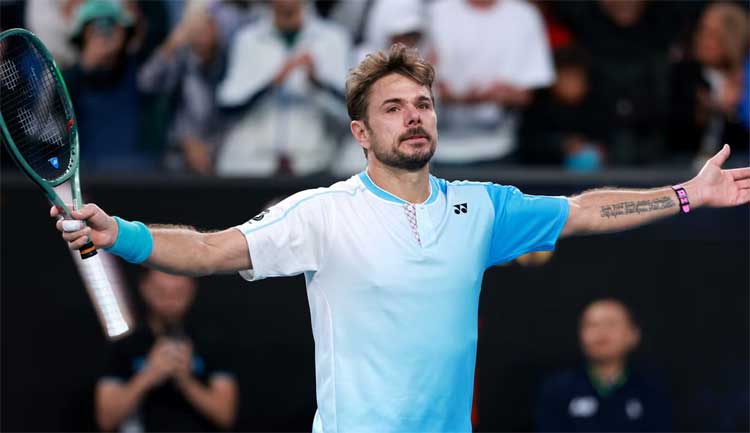
Sometimes, matches are not just about winning or losing, but about what a player represents — a battle-hardened warrior still refusing to bow out with a polite farewell wave.
Three hours and 11 minutes into his Australian Open second-round slugfest, two sets to one down against a Frenchman nearly half his age, 40-year-old Stan Wawrinka faced a set point that could have ended his tournament. Arthur Gea fired a serve down the T, Wawrinka chipped it back, and Gea crushed an inside-out forehand in response.
Deep behind the baseline, Wawrinka shuffled left, bent knees worn down by more than two decades on tour, and unleashed a one-handed backhand that screamed past his charging opponent and clipped the sideline. Index finger to temple — Wawrinka doing Wawrinka things.
For a fleeting moment, it felt like a throwback to 2014, when he won his first Grand Slam at the Australian Open, outduelling Rafael Nadal with that same shot, grit and unyielding resolve.
The power may have dulled slightly over time, but the grit remains intact. On Thursday, the Swiss produced another classic on the Melbourne Park courts, grinding out a 4-6, 6-3, 3-6, 7-5, 7-6 (10-3) victory over the 21-year-old qualifier after four hours and 33 minutes.
In doing so, Wawrinka broke a 48-year-old record, becoming the first player aged 40 or older to reach the third round of a Grand Slam since Ken Rosewall at the 1978 Australian Open.
Wawrinka is the marathon man of modern tennis — not just because he owns the most five-set wins in the Open Era, but because he continues to squeeze every last drop from his reserves even as his career enters its final lap.
“It’s my last Australian Open, so I’m trying to last as long as possible,” said Wawrinka, who has confirmed that his 25th season on tour will be his last. “I’m always going to fight, always leave everything on the court.”
Those words have defined his career, beyond the three Grand Slam titles he claimed during the era of the Big Three, and beyond the rare distinction of beating both Rafael Nadal and Novak Djokovic in major finals between 2014 and 2016.
They also defined this match. After clawing his way back to force a fifth set, Wawrinka endured a deciding stretch that lasted over an hour. Opportunities came and went for both players, and at 40 — after a three-hour, 20-minute first-round match — the physical toll loomed large.
Yet if Wawrinka was feeling it, he did not show it. While he admitted later he “probably started to cramp at the end,” it was Gea who began to look spent, struggling with a knee issue as the match wore on. In the final 10-point tiebreak, Wawrinka mixed deft volleys, clever lobs and measured aggression to close out another marathon.
The performance underlined why Wawrinka boasts one of the best records in five-set matches in tennis history — an Open Era-high 31 wins from 58 deciders.
“I have good confidence in my fitness, that I can handle long matches,” he said. “It’s about pushing myself — physically and mentally.”
At the end, Wawrinka was exhausted. But he is never tired of pushing — not at 40, not after slipping to world No.139 from a career-high ranking of three, and not after a difficult 2025 season that yielded just four wins.
This three-time Grand Slam champion has chosen to stop this year. But he has not stopped chasing balls, points, games or moments like these.
Even with ninth seed Taylor Fritz looming next, and recovery time scarce, Wawrinka’s final Australian Open has already become a fitting reflection of his career.
“It’s a feeling that’s tough to describe,” he said. “But it’s the reason why, at 40, I’m still pushing myself — pushing the limit.”
Comments are closed.