
At BRICS Summit, Modi Slams Global Institutions, Demands Reforms for True Global South Representation

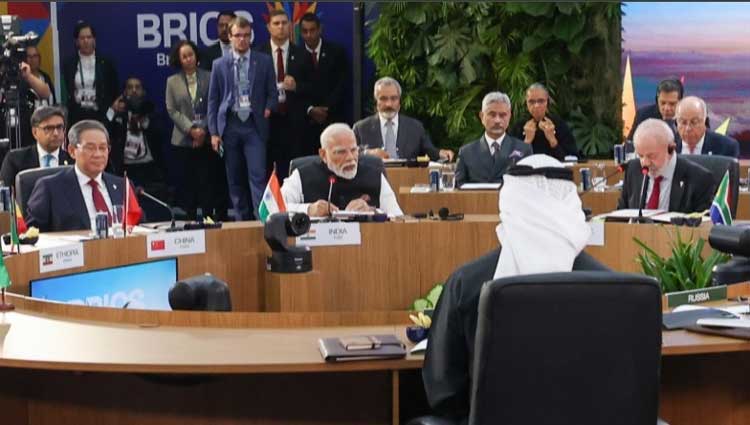
Addressing a BRICS session on peace, security, and global governance reform, Prime Minister Narendra Modi launched a sharp critique of major international institutions, accusing them of being outdated, unrepresentative, and ineffective in addressing modern global challenges.
Modi argued that bodies like the UN Security Council, World Trade Organization (WTO), and multilateral development banks have failed to evolve in nearly eight decades and continue to marginalize the Global South, which he said remains shut out of key decision-making processes.
“Two-thirds of humanity is not adequately represented in global institutions built in the 20th century,” Modi said. “It’s not just a question of representation, but of credibility and effectiveness. Without the Global South, these institutions are like a mobile phone with a SIM card but no network.”
“Nothing More Than Token Gestures”
Modi said countries of the Global South have consistently been shortchanged on issues such as climate finance, sustainable development, and technology access. Calling them “victims of double standards,” he said their priorities — from development to resource distribution and security — are often overlooked or sidelined.
He emphasized that symbolic reforms are not enough:
“Governance structures, voting rights, and leadership positions must change. The challenges faced by the Global South must be at the center of policymaking.”
Call for a New World Order
Modi reiterated India’s call for a new, multipolar, and inclusive world order, one that reflects the realities of the 21st century — including global conflicts, pandemics, financial crises, and emerging threats in cyberspace and outer space.
“You cannot run 21st-century software on 20th-century typewriters,” he said, criticizing the lack of modernization in global institutions. “In an era where AI is updated weekly, it is unacceptable that these bodies haven’t been updated in 80 years.”
India, he said, is prepared to rise above its own national interests to work constructively with BRICS partners toward meaningful global reform.
Expansion of BRICS a Model for Reform
Modi praised the recent expansion of BRICS — which has added Egypt, Ethiopia, Indonesia, Iran, and the United Arab Emirates to the group — as proof of the bloc’s ability to evolve. The BRICS grouping, originally formed in 2009 and joined by South Africa in 2011, now represents a growing alternative to Western-led institutions.
“If BRICS can reform and adapt to the times, so can the UN, WTO, and other institutions,” Modi said.
Terrorism: A Global Stand Needed
Modi also made a forceful appeal for a consistent and principled global stance against terrorism, expressing gratitude to countries that stood with India after the recent Pahalgam terror attack.
“Condemning terrorism should be our principle — not a matter of convenience,” he said. “If we first look at where the attack happened or who it was against before reacting, we betray our shared humanity.”
A Historic Visit
Modi arrived in Brazil earlier in the day, marking the fourth leg of his five-nation tour. After the BRICS summit, he is scheduled to travel to Brasília for a state visit — the first by an Indian Prime Minister to Brazil in nearly six decades — signaling India’s growing outreach to Latin America and the Global South.
Comments are closed.