
America at 250: A nation still grappling with its founding ideals

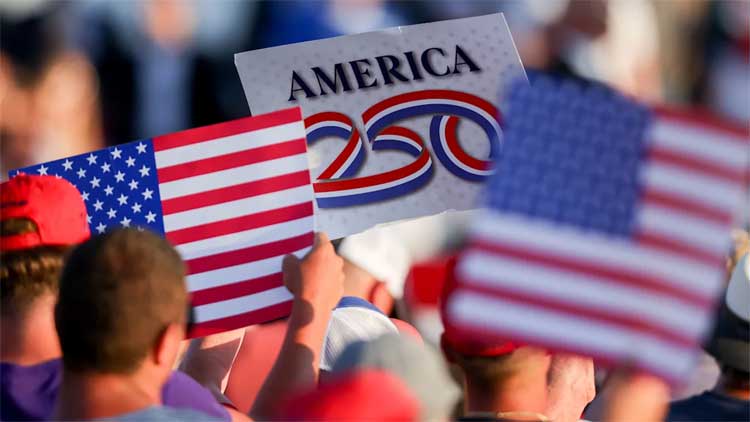
As the United States marks the 250th anniversary of its independence this July 4, the familiar celebrations of fireworks, parades, state fairs, historical re-enactments and backyard barbecues unfold against the backdrop of a nation once again debating its identity and founding ideals.
In many ways, the milestone echoes the country’s origins. In 1776, 56 delegates to the Continental Congress declared independence from Britain, accusing King George III of tyranny and setting the 13 colonies on the path to nationhood. After the Revolutionary War, Britain formally recognized the United States through the Treaty of Paris signed on September 3, 1783.
The country’s early years were marked by conflict and expansion. As the young nation pushed westward, Native American communities were displaced through violence and conquest. The Declaration of Independence itself reflected the prejudices of its era, referring to Indigenous people as “merciless Indian Savages.”
The Declaration also carried a contradiction that has shaped American history ever since. While proclaiming that “all men are created equal” and possess inalienable rights, many of its signatories owned enslaved people. That inconsistency remained unresolved until it exploded into the Civil War in 1861, a conflict that claimed hundreds of thousands of lives and transformed the nation.
Although slavery was abolished, the struggle for racial equality continued through the civil rights movement of the 1950s and 1960s and more recently through the Black Lives Matter movement, underscoring the enduring legacy of America’s original contradictions.
The 250th anniversary arrives during another period of intense national debate. Americans remain divided over issues including immigration, race, free speech, justice and the role of government, while politics continues to reshape long-standing institutions and public norms.
Throughout periods of upheaval, change has remained a defining feature of the American experience. President John F. Kennedy captured that sentiment when he observed that “time and the world do not stand still. Change is the law of life. And those who look only to the past or the present are certain to miss the future.”
Immigration remains one of the country’s most contentious issues. Supporters of a more open immigration system often point to America’s history as a nation built by immigrants and invoke the symbolism of the Statue of Liberty, whose inscription welcomes the world’s “tired” and “poor” seeking freedom. Others argue that the debate today centers on illegal immigration rather than legal migration and highlight the growing political focus on border enforcement and deportations.
Internationally, the anniversary comes as the United States reassesses its role in global affairs. Over the past 250 years, the country has played a decisive role in major world events, from helping defeat Nazi Germany and Imperial Japan during the Second World War to leading the Western alliance throughout the Cold War and projecting military power across the Middle East.
At the same time, several American military interventions have produced mixed or deeply contested outcomes. The wars in Afghanistan and Iraq remain subjects of debate over their long-term costs and consequences, while more recent conflicts continue to shape discussions about Washington’s global strategy.
Despite changes in administrations and foreign policy priorities, many of America’s long-standing partnerships have endured. The US-Saudi relationship, established when King Abdulaziz met President Franklin D. Roosevelt aboard the USS Quincy in 1945, has continued across multiple generations of leaders despite shifting geopolitical realities.
Today, the Declaration of Independence is preserved in the National Archives alongside the US Constitution and the Bill of Rights. Although the ink on the centuries-old document has faded, the principles and debates it inspired remain central to American public life.
For two and a half centuries, the United States has continually grappled with the meaning of liberty, equality and justice. As it enters its next chapter, the nation’s legacy will ultimately be measured not only by the words written in Philadelphia in 1776, but by how successive generations interpret and strive to realize those ideals.
Comments are closed.