
AAIB Forms Three-Member Team to Probe Baramati Plane Crash That Killed Ajit Pawar

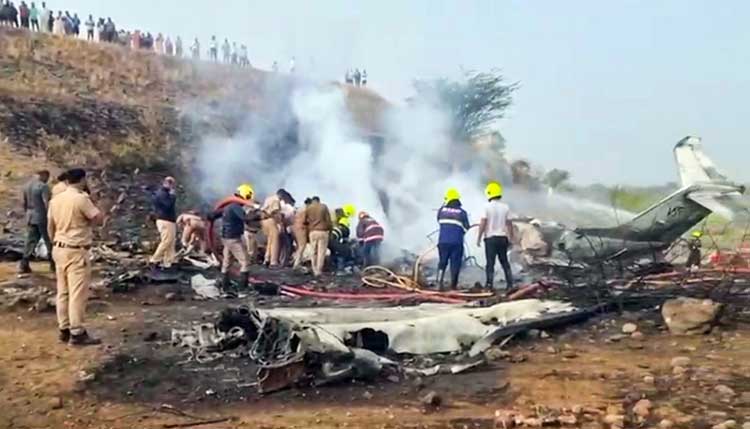
The Ministry of Civil Aviation (MoCA) has constituted a three-member team of the Aircraft Accident Investigation Bureau (AAIB) to probe the plane crash in Baramati that claimed the lives of Maharashtra Deputy Chief Minister Ajit Pawar and four others on January 28.
In an official statement, the ministry said that the AAIB team, along with another three-member team from the Directorate General of Civil Aviation (DGCA), Mumbai Regional Office, reached the crash site on the day of the accident. The Director General of AAIB also visited the site to oversee the investigation.
“The investigation is progressing expeditiously, and the black box of the ill-fated aircraft has been recovered. Ensuring a thorough, transparent, and time-bound inquiry remains a top priority,” the ministry said in a post on X.
Black Box Recovered
Officials confirmed that both the cockpit voice recorder and flight data recorder — collectively known as the black box — have been recovered. These will be analysed to reconstruct the aircraft’s final moments.
The ministry said the probe has been initiated under Rules 5 and 11 of the AAIB Rules, 2025, and will be conducted strictly as per established Standard Operating Procedures (SOPs).
Focus on Visibility and Pilot Decisions
Investigators are examining visibility conditions, pilot decisions, and operational limitations at Baramati, which is an uncontrolled airfield. The crash occurred during the aircraft’s second attempt to land.
A specialised AAIB team began forensic procedures on Wednesday evening, including securing the wreckage, mapping debris patterns, and collecting key evidence.
Authorities have sought detailed documents from the operator, Delhi-based VSR Ventures Pvt. Ltd, including airframe and engine logbooks, maintenance records, inspection histories, work orders, and onboard documents. Crew qualification records and aircraft certification papers have also been requisitioned from the DGCA.
In addition, radar data, air traffic communication recordings, CCTV footage, and hotline exchanges are being analysed to reconstruct the final sequence of events.
Second Landing Attempt Under Scrutiny
The business jet, registered as VT-SSK, was operating a Mumbai–Baramati charter flight when it crashed at around 8.44 am, killing all five occupants — two pilots and three passengers, including Ajit Pawar.
According to the civil aviation ministry, the aircraft departed Mumbai at 8.10 am and contacted Baramati airfield at 8.18 am. During its first approach to Runway 11, the crew reported poor visibility and carried out a standard go-around.
After repositioning, the pilots said they would report once the runway was visible. At 8.43 am, the aircraft was cleared to land, but no readback was received. About a minute later, airfield staff spotted flames near the runway threshold, triggering emergency response.
Baramati is an uncontrolled airfield where air traffic information services are provided by flying training organisations rather than the Airports Authority of India. This aspect is expected to be a key focus of the investigation.
Minister Urges Caution
Union Civil Aviation Minister Ram Mohan Naidu said preliminary inputs indicated poor visibility but warned against premature conclusions.
“The AAIB is the competent authority and will establish the facts through a transparent and accountable investigation,” he said.
In its preliminary note, the DGCA stated that the crew had been advised to descend under visual meteorological conditions at the pilot’s discretion, with reported visibility of around 3,000 metres and calm winds.
Operator Denies Technical Fault
VSR Ventures Pvt. Ltd director Vijay Kumar Singh said the aircraft was properly maintained and airworthy.
“As per our information, there was no technical fault. The pilot took a missed approach due to visibility and attempted a second landing. This is an extremely unfortunate incident,” he said.
He added that the captain had over 16,000 flying hours, while the co-pilot had around 1,500 hours of experience, describing both as seasoned professionals.
The AAIB is expected to submit its detailed findings after completing technical, operational, and forensic analyses in the coming weeks.
Comments are closed.