
COP31 Talks Extend Into Saturday as Countries Clash Over Fossil Fuels and Climate Finance

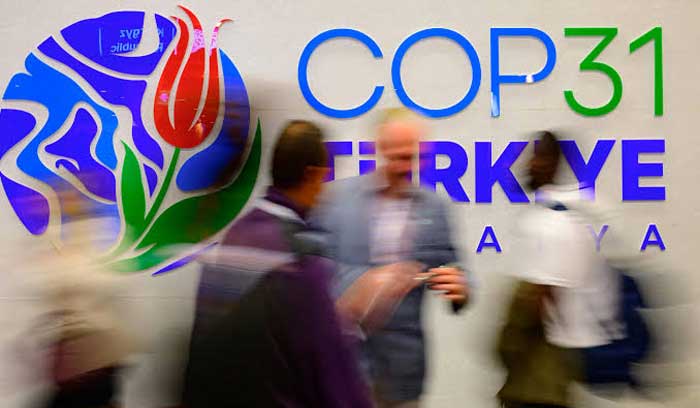
The COP31 climate summit in Turkiye extended into Saturday as nearly 200 countries struggled to reach an agreement, with a revised draft proposal removing all references to fossil fuels and exposing deep divisions over the global response to climate change.
Negotiators worked through the night after two weeks of intense UN-led discussions failed to conclude by the scheduled Friday deadline. Disagreements over energy policy, climate science and financial assistance for developing countries continued to hold up progress.
Australia, which is presiding over the negotiations, faced mounting pressure to produce a third draft agreement as delegates prepared to leave for home.
“We are close to the finish line, but we are not there yet,” COP31 President Murat Kurum, Turkiye’s environment minister, told delegates late Friday after an assembly approved several technical matters.
His address was briefly interrupted when a protester shouted, “You are killing the future!” before being escorted out of the hall.
Expectations of a major breakthrough had remained low throughout the summit, with countries confronting an oil price shock and growing geopolitical tensions linked to the war in Iran.
The conference is taking place against a backdrop of climate-related disasters across Europe, Nepal and Indonesia, while a developing super El Niño pattern is increasing concerns about further extreme weather events.
An earlier draft agreement released during the summit had called for accelerating the phase-out of fossil fuels. However, the proposal became a major point of contention, particularly among oil-producing countries such as Saudi Arabia, which have strongly opposed calls for a rapid transition away from fossil fuels.
A revised draft published on Thursday removed all references to fossil fuels, triggering renewed objections and forcing negotiators back to the bargaining table.
The European Union criticised the revised proposal, warning that it “risks turning this climate COP into a fossil summit”.
On Friday, 12 European and developing countries, including France, Panama and the Solomon Islands, issued a joint letter demanding that the final agreement contain “a clear transition away from fossil fuels”.
Panama went further, threatening to withdraw from the negotiations. Its environment minister, Juan Carlos Navarro, has repeatedly criticised the climate talks, accusing what he called a “petroleum mafia” of obstructing progress.
Meanwhile, the Organisation of the Petroleum Exporting Countries (OPEC) said on social media platform X that its Secretary-General, Haitham Al Ghais, had met Russian presidential climate envoy Ruslan Edelgeriev during the summit. The discussions focused on the importance of “inclusive and balanced approaches across all multilateral environmental fora”.
Clean electrification emerges as a key proposal
Australia’s Climate Minister Chris Bowen spent Friday holding discussions with different delegations in an effort to bridge disagreements and secure compromises.
He said he was prepared to continue negotiations “for as long as it takes, to get the job done”.
One of the central proposals in the draft agreement is a target to electrify the global economy by replacing technologies that directly burn fossil fuels, including diesel-powered vehicles and gas heating systems, with electric alternatives.
Turkiye and Australia, the summit’s hosts, have strongly promoted electrification as a way to improve energy security while accelerating reductions in greenhouse gas emissions.
“Electrification is the key to transitioning away from fossil fuels,” Bowen said, as chair of the negotiations.
The proposal seeks to increase electricity’s share of global final energy consumption to 35 per cent by 2035.
However, the draft does not specify that the additional electricity must come from renewable sources, leaving open the possibility of continued reliance on coal and natural gas.
This has prompted several countries to demand an explicitly defined target for clean electrification, ensuring that increased electricity consumption is supported by low-carbon energy sources.
Another contentious issue is carbon capture technology. Some countries have rejected proposals to expand its use, arguing that the technology remains expensive and insufficiently proven. They also fear it could allow fossil fuel companies to continue operating without making meaningful emissions cuts.
Climate finance and the 1.5°C target remain contentious
Beyond the dispute over fossil fuels, negotiations remain deadlocked over several other major issues, including climate science, emissions reduction commitments and financial assistance for developing nations.
The timing of the next assessment reports by the UN’s Intergovernmental Panel on Climate Change (IPCC) has emerged as another major source of disagreement.
The latest draft expresses “deep concern” about the imminent breach of the internationally agreed 1.5°C warming threshold. However, it removes an earlier proposal calling for global temperatures to be brought back below that level as soon as possible during this century.
Climate finance has also become a major sticking point, with developing countries accusing wealthy nations of failing to meet their financial responsibilities.
The removal of a proposed $120 billion target for climate adaptation funding triggered anger among developing nations, which argue that they need substantially greater financial support to protect vulnerable communities and infrastructure from increasingly severe climate impacts.
Ghana’s Environment Minister Zanetor Agyeman-Rawlings expressed frustration over the lack of progress, saying: “We didn’t come here to beg.”
The disagreements underline the wider challenge facing COP31: securing a meaningful global climate agreement that balances the demands of fossil fuel-producing economies, the urgency of reducing emissions and the financial needs of countries most vulnerable to climate change.
With negotiations extending beyond the official deadline, delegates faced mounting pressure to reach a compromise before leaving Turkiye, even as major differences over the future of fossil fuels and climate finance remained unresolved.
Comments are closed, but trackbacks and pingbacks are open.