
UN Talks Fail to Secure Binding Rules on AI-Powered Killer Weapons

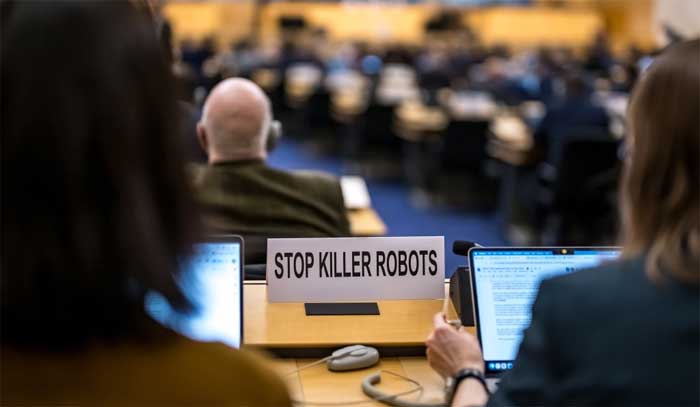
Efforts to establish firm international rules governing AI-powered killer robots and autonomous drones stalled on Saturday after UN-backed talks in Geneva ended with a watered-down agreement to extend discussions for another two years.
At the end of a week-long conference, dozens of countries agreed to continue working towards a possible agreement on lethal autonomous weapons systems by 2028. However, they stopped short of committing to legally binding rules, despite calls from UN Secretary-General António Guterres, several countries and humanitarian organisations for urgent action.
The outcome highlighted the growing difficulty of securing meaningful diplomatic agreements amid global conflicts and competition among major military powers for technological and military dominance.
Izumi Nakamitsu, the UN High Representative for Disarmament Affairs, described the outcome as a “significant achievement” but acknowledged that it could be viewed as a “glass half full or half empty” situation. She noted that Guterres had hoped negotiations towards a legally binding agreement would begin this year.
Advocacy groups, however, criticised powerful military nations, particularly Russia and the United States, for resisting stronger commitments.
The Stop Killer Robots campaign described the outcome as a “watered-down mandate”. Beatrice Fihn, founder of the international law advocacy group Lex International, said the decision amounted to “pushing the can down the road for two more years”.
Although most countries supported continued efforts towards a new treaty, critics argued that further discussions would do little to address the immediate risks. Max Tegmark, a machine learning specialist at the Massachusetts Institute of Technology and founder of the Future of Life Institute, said: “States have agreed it is sufficient to just talk about the issue, for the 14th year, while these weapons enable atrocities.”
Ahead of the conference, seven countries had proposed beginning formal negotiations on rules that could prevent or restrict machines from killing without meaningful human control or accountability. The proposal was supported by Austria, Belgium, Brazil, Ireland, Mexico, New Zealand and Panama but failed to gain sufficient backing.
“Technology is moving faster than diplomacy,” said Brazil’s Ambassador Frederico Meyer, who represented one of the countries pushing for negotiations. “Diplomats are very slow.”
After years of discussions, campaigners expressed frustration over what they described as obstructionism, particularly from Russia. Like the United States and other major developers of AI-powered military technology, Russia has resisted restrictions that could limit the development and deployment of autonomous weapons.
Guterres, whose term as UN Secretary-General ends this year, had set 2026 as the deadline for launching negotiations towards an international agreement on autonomous weapons systems.
Pope Leo XIV, alongside humanitarian organisations and campaigners, has also highlighted the moral and existential implications of autonomous weapons, urging governments to act before such technologies become too widespread to regulate effectively.
Activists warn that armed drones capable of independently selecting and striking targets have already been used in limited instances in conflict zones, although large-scale deployment of fully autonomous killing systems has yet to become widespread.
The discussions took place under the Convention on Certain Conventional Weapons, an international treaty ratified by 128 countries. Its consensus-based decision-making process allows any participating country to block an agreement, making ambitious commitments difficult and often resulting in compromises based on the lowest common denominator.
The latest outcome therefore leaves the international community without binding restrictions on lethal autonomous weapons, extending a debate that has continued for more than a decade.
Comments are closed, but trackbacks and pingbacks are open.