
Amit Shah Says Kashmir Free of Locally Recruited Terrorists After 35 Years

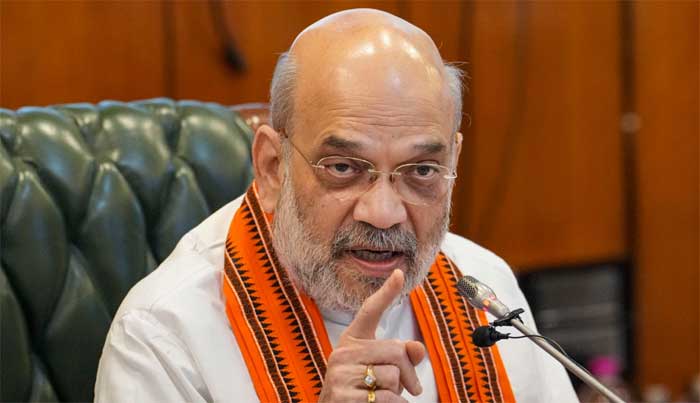
Union Home Minister Amit Shah on Thursday said India has achieved a significant milestone in its fight against terrorism, with the elimination of Lashkar-e-Taiba (LeT) terrorist Latif Bhat making the entire Kashmir free of the presence of India-born terrorists – a situation he said had come about after 35 years.
Addressing the inaugural session of a two-day counter-terrorism conference organised in New Delhi, Shah said India has been a victim of terrorism and has been confronting it for a long time.
“Today, we can say with satisfaction that in this vast country – from Kashmir to Kanyakumari and from Dwarka to Kamakhya – we are putting in place a system under which a uniform strategy to combat terrorism will operate right down to the level of every police station,” he said.
Calls for Coordinated Nationwide Counter-Terrorism Strategy
Emphasising the need for stronger coordination among security agencies, Shah said the lack of coordinated action among state police forces had previously created gaps in India’s counter-terrorism efforts.
He stressed that all agencies must work towards shared objectives, with clearly defined responsibilities and accountability. He also called for a comprehensive approach targeting entire terrorist networks rather than focusing only on individual operatives.
Shah said the government had adopted a zero-tolerance policy towards terrorism under the leadership of Prime Minister Narendra Modi, adding that recent security operations had strengthened the country’s confidence.
The Home Minister also highlighted action against the Shahzad Bhatti network, which has been designated a terrorist organisation under the Unlawful Activities (Prevention) Act (UAPA). According to Shah, more than 40 of its modules have been neutralised, over 100 cases registered and more than 271 arrests made.
He urged state police forces to adopt preventive policing measures, arguing that the ability to identify and apprehend terrorists before they carry out attacks is a key indicator of an effective security agency.
Focus on Terror Financing and International Networks
Shah called for dismantling the entire terror financing chain and improving coordination between security agencies and financial investigation authorities.
He said investigations must extend beyond those directly involved in terrorist activities to identify the wider networks, financial channels and individuals supporting them.
The Home Minister also highlighted the government’s efforts to bring fugitives hiding abroad back to India. He said 303 fugitives had been brought back from 36 countries since 2019 through coordinated efforts involving the Central Bureau of Investigation (CBI), the Ministry of Home Affairs and intelligence agencies.
According to Shah, bringing offenders and masterminds operating from foreign countries before Indian courts is essential to tackling terrorism, organised crime and drug-related activities.
Strengthening Intelligence and Security Infrastructure
The Home Minister called for modernising counter-terrorism capabilities, strengthening state Anti-Terrorism Squads (ATS) and expanding the role of cyber experts in investigations.
He also stressed the need for a stronger intelligence-sharing mechanism through which information collected at police station level could be passed through successive levels of the security establishment to directors general of police (DGPs), enabling timely and actionable intelligence.
Shah further identified the establishment of a Quadrangular Regional Security Grid in border states as an important priority for strengthening national security.
During the conference, Shah released the National Investigation Agency’s (NIA) publication, Fail-Safe Investigation. He also laid the foundation stone for a new NIA office complex in Chandigarh and inaugurated an NIA residential complex at Maidangarhi in New Delhi.
Additionally, he launched the NIA’s ‘Pushti’ portal electronically and conferred decorations on seven agency officers and personnel.
The two-day conference brings together senior police officers from states and Union Territories, central counter-terrorism agencies and experts in law, forensic science and technology. The discussions are focused on strengthening intelligence coordination, improving investigations and developing more effective mechanisms to prevent terrorist activities.
Shah said India’s counter-terrorism approach must increasingly prioritise proactive action, institutional coordination and the dismantling of complete terrorist networks to prevent attacks before they occur.
Comments are closed, but trackbacks and pingbacks are open.