
Delhi Police Tell Supreme Court: Journalists and Reel-Makers Are Different, Defend Action During Jantar Mantar Protest

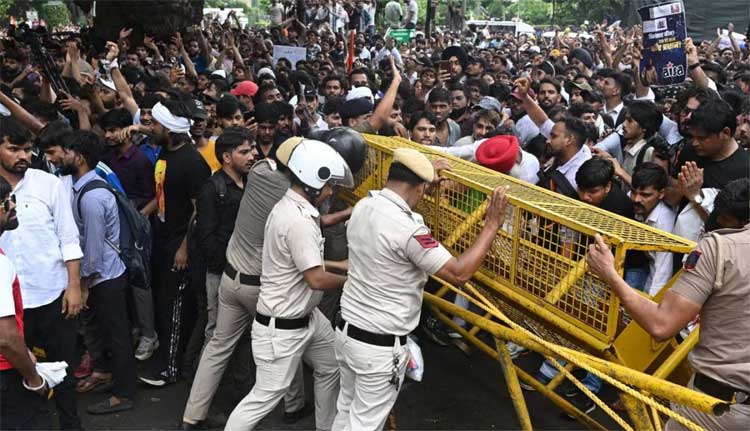
The Delhi Police have told the Supreme Court that professional journalists and social media content creators cannot automatically be treated as the same category, particularly while covering protests and other sensitive public gatherings.
Emphasising that they “fully respect the role of the press”, the police have argued that individuals who use cameras and microphones to create social media reels for commercial purposes cannot automatically claim the same protections as journalists performing professional reporting duties.
In an affidavit submitted to the Supreme Court, the Delhi Police maintained that journalists constitute a distinct category from social media influencers and reel-makers. The submission comes in response to petitions alleging that journalists were subjected to harassment and obstruction while covering protests against the Chief Election Commissioner at Delhi’s Jantar Mantar last month.
The police clarified that they have no objection to individuals recording videos, uploading reels or commercially exploiting their content. However, they questioned whether such activities automatically qualify individuals as journalists or reporters.
Delhi Police Defend Their Conduct During Jantar Mantar Protest
Surender Kumar, Joint Commissioner of Police, filed the affidavit in response to petitions submitted by the Network of Women in Media, Free Speech Collective, Delhi Union of Journalists and Kerala Union of Working Journalists.
The organisations alleged high-handedness by police personnel against journalists covering the anti-Chief Election Commissioner protests at Jantar Mantar.
On October 11, the Supreme Court issued notice on the petitions and directed that lawyers, journalists and other professionals should not be hindered while carrying out their duties in any manner whatsoever.
Responding to the allegations, the Delhi Police said the court’s direction was intended to protect journalists performing their professional responsibilities. However, it argued that the order should not be interpreted as granting blanket protection to social media influencers, reel-makers or unruly elements against the general law or lawful police directions at prohibited assemblies.
The affidavit stated that the police respect freedom of the press and remain committed to protecting journalists’ constitutional rights under Article 19(1)(a), which guarantees freedom of speech and expression.
Police Claim Journalists Were Never Deliberately Obstructed
The Delhi Police rejected allegations that journalists were deliberately prevented from covering the protests. According to the affidavit, representatives from mainstream, national, international, regional, accredited and unaccredited media organisations were present at the gathering and freely recorded the events.
The police cited media coverage by Brut India, The Lallantop, Jist, The Quint, BBC, The Indian Express and other organisations as evidence that journalists were able to report on the demonstrations.
It argued that photographs and videos of the protests were widely published and broadcast across different media platforms, contradicting claims that the press had been prevented from witnessing or reporting the events.
The affidavit further stated that any interference or confusion involving journalists, if it occurred, was inadvertent and resulted from mistaken identity or crowd-control measures.
The police maintained that there had been no deliberate or coordinated attempt to obstruct journalists carrying out their professional duties. It also claimed that individuals apprehended because of mistaken identity were immediately released after their identities were verified.
Reel-Makers Allegedly Participated in Protest, Says Police
A major argument in the Delhi Police affidavit concerns individuals who allegedly identified themselves as media personnel while participating in the demonstrations.
The police claimed that some protesters were carrying cameras and microphones and presenting themselves as journalists despite not being engaged in professional reporting.
According to the affidavit, several content creators were making YouTube videos and social media reels at the protest site, making it difficult for police personnel to distinguish professional journalists from other individuals.
The police also referred to videos circulating on social media in which certain individuals identifying themselves as media personnel could allegedly be seen raising slogans alongside protesters.
The affidavit argued that such conduct suggested that some individuals were participating in the demonstration rather than covering it in their professional capacity.
However, the police maintained that even reel-makers and content creators were not obstructed unless their presence or activities interfered with the maintenance of public order and law and order.
Why Police Asked Camera Operators to Maintain Distance
The Delhi Police also defended asking individuals carrying cameras to maintain a reasonable distance from operational areas.
According to the affidavit, some individuals continued to remain close to police personnel and operational zones while recording the proceedings, despite being asked to move away.
The police cited the large size and density of the gathering, along with rapidly changing circumstances, as reasons why officers on the ground could not always immediately distinguish journalists from protesters.
It argued that individuals moving within the crowd and approaching the immediate vicinity of police operations created additional challenges during crowd-control activities.
The police said these measures were necessary to maintain public order and ensure the safety of people present at the site.
Delhi Police Issue Guidelines for Journalists
Another important aspect of the affidavit concerns the guidelines issued by the Delhi Police for journalists on October 5, 2026.
The guidelines were circulated through social media platforms, including Facebook, Instagram, X and Telegram.
Under these guidelines, journalists were advised to:
- Carry valid identity cards while covering events.
- Display their press identification prominently.
- Avoid obstructing police operations.
- Maintain a reasonable and safe distance from operational areas.
Defending the guidelines, the police described them as precautionary and facilitative measures designed to help officers identify genuine journalists and ensure their safety during sensitive situations.
The affidavit clarified that these guidelines were not intended to restrict anyone’s right to gather, record or disseminate information.
The police also acknowledged that not every working journalist possesses accreditation from the Press Information Bureau (PIB). Therefore, the guidelines allowed journalists to present identity cards issued by their respective media organisations as an alternative means of identification.
According to the police, this approach ensured that the absence of PIB accreditation alone would not prevent journalists from being recognised or allowed to perform their professional duties.
Accreditation and the Difference Between Journalists and Content Creators
The Delhi Police also referred to the definition of a working journalist under the Occupational Safety, Health and Working Conditions Code, 2020.
The affidavit argued that the term ‘working journalist’ has a distinct meaning in the digital era, when social media platforms have created new forms of content production and distribution.
It referred to existing journalist accreditation guidelines and urged the Supreme Court to examine the difference between professional journalism and content creation for commercial purposes.
According to the police, professional journalism involves reporting facts witnessed on the ground in a neutral manner, without fear or favour. In contrast, recording events primarily to create content and subsequently monetise it may involve a different purpose.
The affidavit suggested that the predominant intention behind an individual’s activity could be an important factor in determining whether that person is performing journalistic duties or creating content for social media.
However, the police did not suggest that every journalist must possess PIB accreditation, noting that employer-issued identity cards could also be accepted.
Freedom of Press Remains Central to the Legal Dispute
Concluding its submissions, the Delhi Police described journalists as the flag-bearers of democracy and stated that their rights must be respected and protected.
The affidavit reiterated that freedom of the press is an essential part of the constitutional guarantee of freedom of speech and expression under Article 19(1)(a).
At the same time, the police argued that the protections available to journalists should not automatically exempt every individual carrying a camera or microphone from complying with lawful police instructions.
The matter places an important question before the Supreme Court: how should the rights of professional journalists be protected while distinguishing their reporting activities from social media content creation during sensitive public gatherings?
The court’s consideration of the petitions could have implications for journalists, independent reporters, digital media professionals and social media creators covering protests and public events across the country.
Comments are closed, but trackbacks and pingbacks are open.