
India Stage Stunning Comeback to Beat Japan 4-1 and Claim Sixth Asian Champions Trophy Title

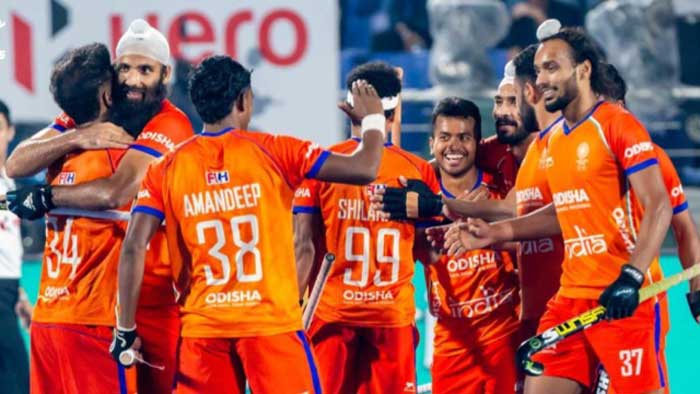
India produced a remarkable second-half comeback to defeat Japan 4-1 in the Asian Champions Trophy final at the Balbir Singh Senior International Stadium in Mohali, overcoming an early setback to secure their sixth title in the competition.
Although the scoreline suggested a comfortable victory, the final was anything but straightforward. It featured early disappointment, prolonged frustration and a spectacular attacking resurgence that ultimately sealed India’s triumph.
The atmosphere before the match was festive, with Bhangra music reverberating through the stands and supporters anticipating another Indian victory. Confidence was high, particularly after the hosts had defeated Japan by the same 4-1 margin during the group stage.
However, the celebrations quickly gave way to silence when Kazumasa Matsumoto opened the scoring with a superb reverse-hit in the third minute.
India spent much of the next 39 minutes searching for an equaliser, struggling to penetrate Japan’s disciplined defence despite creating several opportunities.
The breakthrough finally arrived in the 42nd minute when Shilanand Lakra converted from close range to bring India level and transform the momentum of the contest.
Six minutes later, Dilpreet Singh put India ahead. Jugraj Singh extended the advantage with a penalty-corner conversion before Vivek Sagar Prasad completed the scoring, capping a remarkable 12-minute attacking burst that secured India’s sixth Asian Champions Trophy crown.
Japan’s defensive wall frustrates India
Patience proved essential as Japan maintained a compact defensive structure and repeatedly frustrated India’s attacking efforts.
Abhishek Nain, Dilpreet Singh, Sukhjeet Singh and Hardik Singh all missed opportunities during the opening quarter, while Japanese goalkeeper Kisho Kuroda produced several important saves to keep the hosts at bay.
The second quarter followed a similar pattern. India controlled much of the possession and created more opportunities inside the attacking circle, but Japan’s disciplined marking prevented them from converting their dominance into goals.
At half-time, the statistics reflected India’s superiority in most departments, except the most important one.
India recorded 11 circle penetrations against Japan’s six and managed two shots on target compared with Japan’s one. The hosts also enjoyed 52 per cent possession.
However, Matsumoto’s early strike remained the difference between the teams.
Japan also demonstrated that their strategy involved more than simply defending deep, earning two penalty corners during the first half, while India failed to win any.
Lakra’s equaliser sparks India’s revival
Japan relied heavily on tight man-to-man marking, making it difficult for Indian forwards to find space or create clear scoring opportunities.
India needed greater creativity and better coordination in midfield to break through the defensive structure.
Hardik Singh and Nilakanta Sharma began producing more effective attacking combinations during the third quarter, gradually increasing the pressure on Japan’s defence.
Their efforts earned India two penalty corners in quick succession, with the second eventually leading to the equaliser.
Kuroda initially stopped Harmanpreet Singh’s drag-flick, but Aditya Lalage collected the rebound and delivered a pass towards Shilanand Lakra, who finished from close range in the 42nd minute.
Japan challenged the decision, questioning whether Aditya’s aerial pass constituted dangerous play. However, the video umpire ruled that the delivery was legal and allowed the goal to stand.
Japan subsequently replaced Kuroda with Takumi Kitagawa in goal, but the change did little to alter the momentum.
India continued attacking with renewed confidence, and the goals soon followed.
Dilpreet Singh gave the hosts the lead after receiving a pass from Hardik Singh. Jugraj Singh then converted a penalty corner to make it 3-1, before Vivek Sagar Prasad completed the comeback by scoring from a rebound off Shilanand’s attempt.
The four-goal burst turned a difficult final into a memorable championship triumph.
Harmanpreet credits belief and tactical adjustments
Indian captain Harmanpreet Singh acknowledged that Japan had the upper hand during the opening two quarters but praised his teammates for maintaining their belief and adapting their approach.
“Their opening goal showed that they had come with a plan. We missed some opportunities in the first two quarters but we knew we could make a comeback. Japan were marking man-to-man. We had to depend on zonal (marking). The midfield needed stepping up,” he told The Indian Express.
He said the team’s message during the difficult phase was to remain confident and stick to their tactical structure.
“The message to the team was to believe in ourselves. We knew that if we stick to our plans and structure, goals will come,” he added.
Fulton sees victory as important preparation for LA Olympics
Head coach Craig Fulton said he was not overly concerned by India’s early struggles, pointing to the team’s previous comebacks against Japan and South Korea during the tournament.
“Japan had a very good half. But we came back against Japan and Korea. So we had the belief that we could make a comeback. We were not down by three goals,” Fulton told The Indian Express.
He said India increased their intensity and attacking pressure during the final two quarters.
“Then we got four goals. We went for full press and full effort in the last two quarters and we knew we could do better,” he said.
Fulton also described the tournament victory as an important step towards India’s preparations for the 2028 Los Angeles Olympics.
“These matches were very important, as the focus now shifts to how we enter the next 18 months prior to the LA Olympics with some new faces. The experienced guys and the youngsters will learn like they learned from this tournament,” he said.
Beyond the trophy and the convincing final scoreline, India’s campaign offered valuable lessons in patience, tactical flexibility and the importance of maintaining belief under pressure.
Their comeback against Japan demonstrated how quickly a match can change when a team combines composure with renewed attacking intent. As preparations for the Los Angeles Olympics gather momentum, the triumph provides both confidence and important experience for India’s evolving squad.
Comments are closed, but trackbacks and pingbacks are open.