
India Yet to Commit to Global ‘35 by 2035’ Electrification Target Ahead of COP31, Says Bhupender Yadav

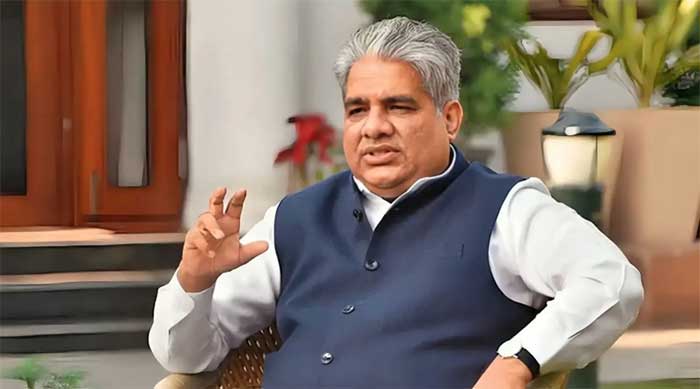
India has not yet decided whether to support a proposed global target to increase the share of electricity in total energy consumption to 35% by 2035, Union Environment Minister Bhupender Yadav said on Tuesday, stressing that climate commitments must take into account national priorities, economic conditions and energy requirements.
Speaking ahead of the 31st United Nations Climate Change Conference (COP31), scheduled to begin in Antalya, Türkiye, next week, Yadav said every country must be allowed to frame its climate policies in accordance with its national circumstances, sovereignty and poverty-eradication objectives.
He emphasised that India would continue to advocate the principles of equity and common but differentiated responsibilities and respective capabilities (CBDR-RC) in international climate negotiations.
The minister also maintained that an immediate phase-out of fossil fuels was not practical for India, as ensuring affordable and reliable energy access for ordinary citizens remained a key government priority.
India stresses climate equity and national priorities
Yadav said India’s approach to climate negotiations would focus on ensuring that developing countries are not subjected to uniform targets without considering their different levels of development and financial capabilities.
According to the Environment Ministry, India will argue that voluntary initiatives under the COP31 Presidency’s Action Agenda should remain separate from formal negotiations and that global targets must respect individual countries’ national circumstances.
“India will always be part of the solution, not part of the problem,” Yadav said, reaffirming the country’s commitment to international climate action.
He added that the principles of equity, common but differentiated responsibilities and respective capabilities must be fully respected in climate-related decisions.
India is also expected to work with developing-country groupings, including the G77 and China, the Like-Minded Developing Countries (LMDC) and BASIC, to advance the interests of the Global South.
What is the ‘35 by 2035’ electrification target?
The proposed global electrification target was introduced by Türkiye’s COP31 presidency in June 2026 as part of its climate action agenda.
It aims to increase electricity’s share of global final energy demand from just over 20% currently to 35% by 2035.
The initiative is intended to accelerate the transition towards electricity-based systems in transportation, buildings and industrial operations, reducing dependence on direct fossil-fuel consumption.
Türkiye has also proposed other climate targets, including halving the growth of global waste by 2035 and reducing energy consumption intensity in the building sector by at least 25% over the same period.
The electrification proposal is a voluntary initiative under the COP31 Presidency’s Action Agenda rather than a binding commitment under formal climate negotiations.
India has indicated that any decision on supporting such targets will require consideration of its domestic development needs and energy requirements.
Fossil fuels remain important for India’s energy security
Yadav said an immediate transition away from fossil fuels would not be feasible for India, given the country’s development priorities and the need to provide affordable energy to its population.
India’s position is that climate action must be balanced with economic growth, energy security and poverty eradication.
The government is expected to emphasise the importance of a just energy transition that allows developing economies to expand access to reliable and affordable energy while gradually adopting cleaner technologies.
Climate finance to remain a major priority at COP31
Apart from electrification and energy transition, India will push for stronger commitments from developed countries on climate finance.
Yadav said India would seek a COP31 decision to begin the Climate Finance Work Programme, stressing that financial assistance must be predictable, largely public and concessional, without increasing the debt burden of developing nations.
The government will also focus on technology transfer, adaptation financing and support for climate-resilient development.
India is expected to argue that developing countries require adequate financial resources and access to affordable technologies to meet their climate commitments.
India seeks practical outcomes at Antalya climate summit
COP31 will take place in Antalya, Türkiye, from November 9 to 20, 2026, with India preparing to play what Yadav described as a constructive and bridge-building role.
The country’s priorities will include climate finance, adaptation, technology transfer, just transition and ensuring that mitigation commitments remain nationally determined and non-punitive.
India will also highlight the relationship between climate adaptation, agricultural sustainability, food security and the livelihoods of small and marginal farmers.
As international climate negotiations enter another crucial phase, New Delhi’s position is expected to centre on balancing global environmental responsibilities with the development needs of emerging economies.
Yadav’s remarks make clear that India intends to remain engaged in international climate action while maintaining that energy access, poverty reduction and national sovereignty must remain central to decisions on the global energy transition.
Comments are closed, but trackbacks and pingbacks are open.