
Venezuelans Demand Free Elections in First Nationwide Protest in Nearly Two Years
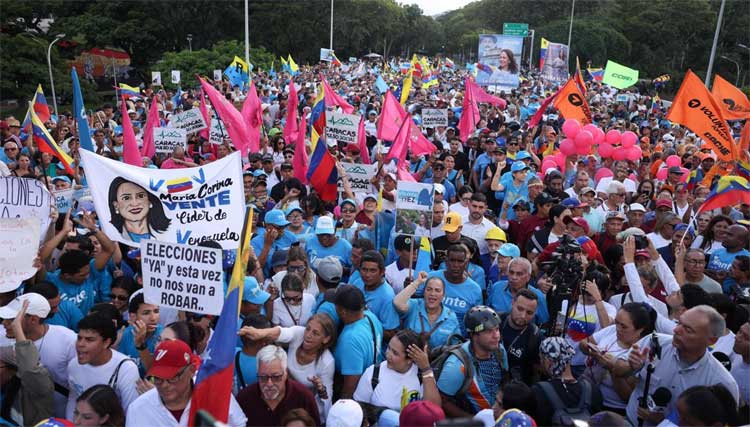
Thousands of Venezuelans took to the streets on Thursday in the country’s first nationwide opposition protest in nearly two years, demanding free elections and broader political reforms.
The United States has been working closely with Venezuela’s interim government, led by acting President Delcy Rodriguez, since US forces captured President Nicolas Maduro in January. Both US President Donald Trump and Rodriguez, Maduro’s former deputy, have said elections will be held but have yet to announce dates for legislative or presidential votes.
Opposition leader and Nobel Peace Prize laureate Maria Corina Machado, who has been outside Venezuela for nearly a year after spending months in hiding following the disputed 2024 election, has said elections must take place by July 2027.
Her political movement, Vente Venezuela, organized Thursday’s demonstrations in Caracas and other cities, including Valencia, Maracay, San Cristobal and Maracaibo.
“Seeing this makes me happy because I know change is possible,” said 18-year-old cosmetology student Leosmary Hernandez, who joined hundreds of demonstrators in northern Maracay.
“I’ve been through so many hardships, so many problems because of the dollar, and difficulties studying. I have high hopes for my country and for our next leader, president, Maria Corina,” she said.
“I went out to protest before, when things were much tougher, and I’m even less afraid today because I want my voice to be heard,” Hernandez added as music played and protesters waved Venezuelan flags.
Venezuela’s socialist movement has been in power since 1999, first under the late President Hugo Chavez and later under Maduro. Authorities have previously deployed security forces against demonstrators protesting political repression, soaring inflation, poor public services and other problems in the economically battered country, including in the aftermath of the 2024 presidential election.
The ruling Socialist Party called on its supporters to march from Caracas’ Plaza Venezuela to a location near the presidential palace to mark breast cancer awareness month. The march was scheduled to begin two hours before the opposition gathering at the same plaza.
Interior Minister Diosdado Cabello, who is known for his close ties to the security services, appeared on state television attending the ruling party’s march. Opposition supporters subsequently moved their demonstration to a nearby location.
Negotiations Continue
US-backed negotiations between a faction of the opposition and the interim government are continuing, with the aim of reforming the country’s top court and electoral council to help ensure fair future elections. The latest round of talks took place this month, although implementing changes could take considerable time.
Machado’s political movement is not participating in the negotiations, but she has said she will not obstruct their progress.
Machado’s proxy won the 2024 presidential election by a wide margin, according to vote tallies published by the opposition. The government, which never released a complete set of results, maintained that Maduro had won, a position supported by the country’s legal and electoral institutions.
After several of her closest collaborators were arrested, Machado went into hiding. Her last public appearance in Venezuela was at demonstrations marking Maduro’s third inauguration in January 2025, when she was briefly detained.
For years, Machado has sought US support, aligning herself with hawks in the Trump administration who argued that Maduro posed a direct threat to US national security through alleged links to drug gangs. Maduro and his wife, Cilia Flores, are facing drug-related and torture charges in the United States. Both have pleaded not guilty.
Trump, however, has repeatedly praised Rodriguez’s leadership and her willingness to welcome US investors. Last month, he said it was too early to consider holding elections.
Machado’s desire to return to Venezuela, particularly following devastating twin earthquakes in June, has created friction in Washington. US officials have asked her to postpone her trip, Reuters has reported.
Calls for Political Prisoners’ Release
Demonstrators also called for the release of people they say have been imprisoned for political reasons.
Foro Penal, a legal rights organization that represents opposition figures and others detained on charges including treason, says more than 320 political prisoners remain in Venezuela, despite releases under an amnesty law backed by the legislature earlier this year.
The government has repeatedly denied holding political prisoners and has described the amnesty as generous.
Comments are closed, but trackbacks and pingbacks are open.