
Solar Kits Bring Power To Disaster-Hit Communities And Rohingya Refugee Camps

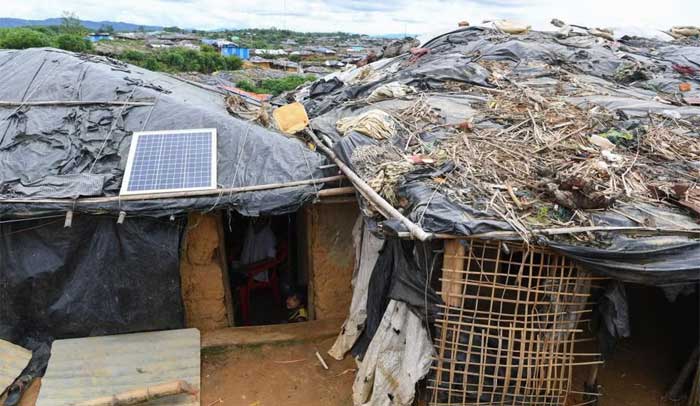
Portable solar energy kits are increasingly becoming a lifeline for refugees and disaster-hit communities, offering access to electricity as climate change intensifies extreme weather and conflicts disrupt conventional energy supplies.
In Bangladesh’s Teknaf region, Mohammed Saber, 35, places a rectangular solar panel on the roof of the bamboo-and-tarpaulin shelter where he lives with his family. The Rohingya family fled Myanmar’s military crackdown in 2017 and has relied on the portable solar kit it received as humanitarian aid six years ago.
The kit has become the family’s primary source of electricity, making everyday life in the refugee camp significantly easier.
“We can now charge our phones, cook with light, children can study at night and use fans during the hot season,” Saber said.
From flood-affected areas of Nepal to refugee camps across Africa, humanitarian organisations are increasingly turning to solar energy as technology improves and costs decline. Experts say access to electricity is a basic necessity in emergencies, particularly as wars, sanctions and political instability make fossil fuel prices unpredictable.
Portable Solar Kits Offer Immediate Relief
Solar kits are compact, rechargeable systems that operate independently of the electricity grid, making them particularly useful when conventional power infrastructure is damaged or unavailable.
Sarah Rosenberg-Jansen, a research fellow at the Stockholm Environment Institute, said these systems can be deployed quickly during emergencies and transported to areas where rising floodwaters, shifting conflict lines or damaged roads make aid delivery difficult.
The technology ranges from solar lanterns and torches to home electricity systems, heating pads and electric cooking appliances powered by solar energy.
Such portability allows humanitarian organisations to provide electricity to displaced families and communities without waiting for damaged power networks to be restored.
Falling Solar Costs Boost Disaster Relief Efforts
The declining cost of solar technology has helped expand its role in humanitarian operations. Unlike fossil fuels, solar energy does not require regular fuel deliveries, which can become expensive and difficult during emergencies.
Rosenberg-Jansen said advances in technology and mass manufacturing have made solar energy more affordable than it was just a few decades ago.
Yuriy Boyechko, chief executive of US-based nonprofit Hope For Ukraine, which distributes solar kits to families affected by the war in Ukraine, said the systems are also easy to operate.
“We have grandmas and grandpas who are around 75-80 years old … receiving kits,” Boyechko said. “It’s just a matter of plug (in) and play.”
Solar-powered solutions are also being deployed in other crisis-hit regions.
On the outskirts of Karachi, Pakistan, a tuberculosis clinic operated by Doctors Without Borders uses solar energy. In South Sudan’s Renk county, the UN migration agency has installed solar-powered water filtration systems to support families displaced by the conflict in neighbouring Sudan.
Solar kits were also distributed in Nepal following devastating floods in August that, according to the figures cited in the report, killed 1,455 people and left 5,285 missing. Local and international organisations, including Australia-based charity SolarBuddy, participated in the relief effort.
Funding Cuts And Bureaucracy Slow Solar Adoption
Despite their growing importance, funding shortages and institutional barriers continue to hamper the adoption of renewable energy in humanitarian operations.
Mark Gibson of the Global Platform for Action (GPA), an initiative promoting affordable, reliable and clean energy access, said aid agencies often rely on established arrangements involving diesel generators and long-term fuel supply contracts.
Transitioning to solar energy requires organisations to adopt new systems, develop distribution networks and establish reliable supply chains, often in challenging or insecure environments.
Reductions in international donor funding have further undermined these efforts.
Aimee Jenks, a programme leader at GPA, said cuts to humanitarian funding had also reduced technical expertise in the sector.
“Much of the technical expertise in the humanitarian sector on energy has been cut,” she said. “That’s now retracting a lot of progress.”
Although solar technology has become cheaper, it remains unaffordable for many families and organisations without external assistance.
Hope For Ukraine expects to have distributed more than 3,200 solar kits by the end of 2026. However, Boyechko said funding constraints had limited the pace of distribution.
“But it took us two years to get to that number, because of funding needs,” he said. “We have a waiting list of about 20,000 families. We just cannot keep up with demand.”
Solar Power Offers Hope To Displaced Families
Experts say expanding access to renewable energy could reduce dependence on polluting fossil fuels while helping vulnerable communities cope with disasters and prolonged emergencies.
For Saber and his family, the benefits are immediate and personal. Among more than one million Rohingya refugees from Myanmar living in Bangladesh, his family depends on the solar kit to maintain access to basic electricity.
“It’s improved my family’s life,” he said.
Comments are closed, but trackbacks and pingbacks are open.