
US Suspends PERM Processing For Indian IT Giants, But Impact May Be Limited

The US administration’s move to suspend permanent labour certification processing for major IT companies, including Tata Consultancy Services (TCS), Infosys, Wipro and HCLTech, may have a limited immediate impact on India’s IT services sector, as these firms account for only a small share of total applications.
The US Department of Labor announced the suspension on Thursday, affecting a key step in the process through which foreign workers can seek permanent residency, commonly known as a green card. However, government data suggests that Indian IT companies collectively accounted for fewer than 1,400 of the 117,849 permanent labour certification requests filed during the latest reported period.
US Suspends PERM Processing For Major IT Firms
US Labour Secretary Keith Sonderling announced that the department would stop accepting new applications and processing pending permanent labour certification applications involving several major outsourcing and technology companies.
The companies named included Cognizant, Infosys, Tata Consultancy Services, Wipro, HCLTech and Capgemini. Sonderling also announced the suspension of Microsoft and Adobe from the programme, citing multiple active federal investigations.
“We will not accept any new or process any pending permanent labor certification applications involving these companies,” Sonderling said.
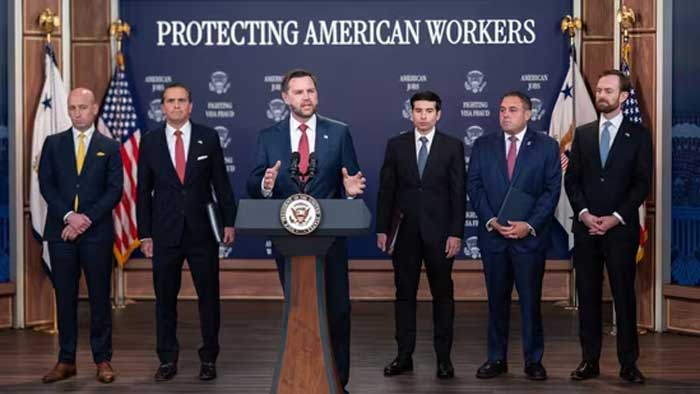
The announcement forms part of the Trump administration’s broader effort to tighten oversight of employment-based immigration and prioritise American workers.
What Is PERM And How Does It Affect Green Card Applications?
The Program Electronic Review Management (PERM) process is a key step in many employment-based green card applications.
Before sponsoring a foreign employee for permanent residency through the relevant employment-based route, an employer generally must obtain labour certification from the Department of Labor.
The process requires employers to advertise the position, consider qualified US applicants and demonstrate that hiring a foreign worker will not adversely affect the wages or working conditions of similarly employed American workers.
After the labour certification is approved, the employer can proceed with the relevant immigration petition before US Citizenship and Immigration Services (USCIS), subject to the applicable requirements.
The suspension affects this certification stage for the named companies. It does not automatically mean that existing H-1B visa holders lose their work authorisation or that all green card applications across the US have been halted.
Indian IT Companies Account For Less Than 2% Of PERM Filings
Data from the US Department of Labor indicates that the six outsourcing firms named in the suspension accounted for fewer than 1,400 cases out of 117,849 permanent labour certification requests filed between October 2024 and September 2025, representing less than 2% of the total.
The data also highlights the differences between individual companies’ PERM activity.
During the reported period, Wipro received 523 permanent residency approvals, while TCS recorded 513 and HCLTech 393, according to the US government’s PERM disclosure data for fiscal year 2025. Infosys has reportedly had no PERM cases since 2022.
By comparison, Microsoft was the country’s largest PERM filer in fiscal year 2025, with 3,161 cases decided—more than twice the combined number for the six outsourcing firms named in the suspension.
These figures suggest that the immediate disruption to the overall PERM system could be limited in scale for Indian IT services companies, although the effects may vary depending on individual employers and their workforce requirements.
US Accuses Companies Of Misusing H-1B Visa Programme
The action comes amid criticism from the Trump administration that some employers have used the H-1B visa programme to hire foreign workers at lower wages instead of employing Americans.
US Vice-President JD Vance said the programme was intended to allow companies to recruit highly skilled workers for positions that could not be filled by American employees, but alleged that it had become vulnerable to fraud.
Sonderling similarly accused major companies of enabling abuse of the system and said the administration wanted to direct more employment opportunities towards American workers.
The companies named in the suspension have not been established to have committed wrongdoing merely because the administration announced the measure. The allegations and the scope of the federal investigations remain important considerations in assessing the action.
Why Indian IT Firms May Avoid An Immediate Crisis
Phil Fersht, chief executive of HFS Research, said the suspension was unlikely to trigger an immediate project-delivery crisis because PERM certification is distinct from an H-1B visa or other work authorisation.
“I would not expect an immediate project delivery crisis. PERM is not the same as an H-1B or other work visa; so, existing employees do not suddenly lose their ability to work because their green card process is suspended,” Fersht said.
However, he warned that the consequences could become more serious if the restrictions remain in place over the medium term.
“These firms depend on experienced domain, technology and client-facing talent in the US, and uncertainty around permanent residency can drive attrition precisely among the people they most want to retain,” he added.
For Indian IT companies, the main concern may therefore be less about an immediate loss of work authorisation and more about retaining experienced employees who are seeking long-term settlement in the US.
What The PERM Suspension Means For Indian IT Workers
The suspension creates uncertainty for employees of the affected companies who are relying on employer-sponsored permanent residency applications. Those whose cases are pending could face delays, while employers may have to reassess their immigration and talent-retention plans.
The immediate impact on existing employees will depend on their individual visa status and circumstances. Workers should not assume that the suspension automatically cancels their current work authorisation, but those with pending green card cases may need advice from their employer’s immigration counsel.
If the suspension continues, uncertainty over permanent residency could make it harder for Indian IT companies to retain specialised professionals and plan long-term staffing in the US.
For now, the relatively small share of PERM filings accounted for by Indian outsourcing companies points to a potentially limited immediate impact. The longer-term consequences will depend on the duration and scope of the suspension and how the affected companies respond.
Comments are closed, but trackbacks and pingbacks are open.