
EU Trade Chief Heads To China For Talks To Ease Escalating Trade Tensions

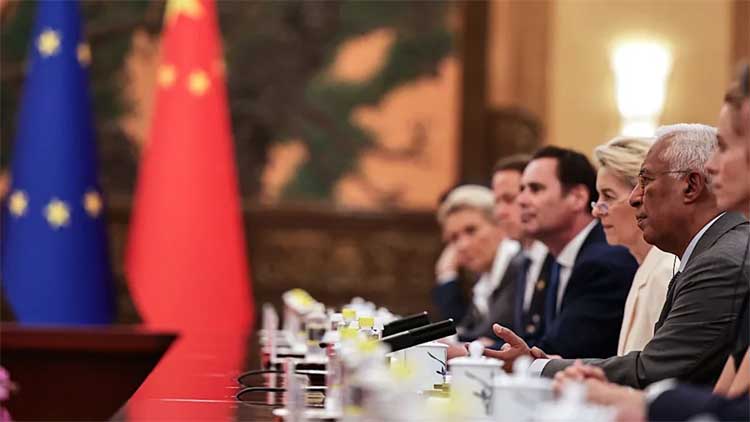
The European Union’s top trade official will visit China on Thursday for two days of talks aimed at easing growing trade tensions and preventing a mutually damaging trade war.
EU Trade Commissioner Maros Sefcovic’s visit comes as Brussels seeks to address its massive trade deficit with China, which stood at around one billion euros ($1.1 billion) a day last year.
The EU has long accused Beijing of unfair trade practices, but the bloc is also wary of provoking China over its dominance of rare earth minerals, which are crucial to Europe’s industrial sector.
France, Germany Push For Stronger EU Response
Sefcovic’s talks in Beijing come as France and Germany push the European Union to prepare tougher measures against potential Chinese trade retaliation.
French President Emmanuel Macron and German Chancellor Friedrich Merz have urged the EU to develop a “credible instrument” capable of responding rapidly to any escalation by Beijing, according to a letter seen by AFP.
The proposed mechanism, which is expected to be discussed at an EU leaders’ summit next week, would give the European Commission greater power to respond to trade aggression within days.
China Warns Against ‘Protectionist’ Measures
Beijing quickly responded to the Franco-German initiative, warning Paris and Berlin against adopting what it described as protectionist policies.
“We hope that France and Germany, as major economies in the world, will uphold openness, cooperation and free trade,” China’s commerce ministry said Tuesday.
It also urged the two countries to avoid what it called the “wrong path,” warning that they could ultimately face negative consequences themselves.
China also has a strong interest in keeping trade relations with Europe stable. Beijing is increasingly dependent on exports to support its economy amid weak domestic demand.
EU Sees China’s Economic Struggles As Leverage
Bernd Lange, chairman of the European Parliament’s trade committee, said China’s economic difficulties could strengthen the EU’s negotiating position.
“The EU has a well-supplied toolbox to counter unfair subsidies, dumping, discriminatory procurement, and economic coercion,” Lange said, calling for those instruments to be applied consistently and strengthened where necessary.
Brussels Seeks ‘Tangible Results’
EU and Chinese officials have been negotiating since June, with Sefcovic previously saying he wanted to secure “tangible results by October.”
The EU’s priorities include curbing rising Chinese imports in strategically important sectors, increasing European exports to China and securing better access to critical raw materials.
Brussels is also seeking clearer arrangements for Chinese exports of rare earths and other critical materials after Beijing imposed restrictions last year.
The EU hopes to negotiate voluntary export limits in some sectors, potentially including hybrid vehicles shipped to Europe. China, however, has opposed import quotas.
Analysts Expect Limited Progress
Analysts remain cautious about the possibility of a broad trade agreement emerging from this week’s discussions.
“If one sector could be identified in which an export-restraint agreement with China could be tested, that would be a good step,” Ignacio Garcia Bercero of Brussels-based think tank Bruegel told AFP.
Zhu Tian, an economics professor at Shanghai’s China Europe International Business School, similarly said the talks could produce agreements on “some specific issues,” though a comprehensive breakthrough remains uncertain.
Comments are closed, but trackbacks and pingbacks are open.