
Nepal-Tibet disaster linked to climate change – a glaciologist explains

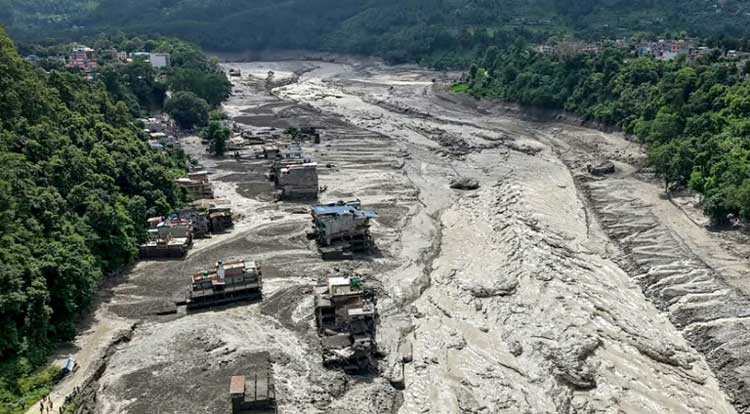
The catastrophic flash floods that swept through the Nepal-Tibet border region on August 26 have raised fresh questions about the growing impact of climate change on the Himalayas. Scientists say a glacier collapse appears to have triggered the disaster, but they caution that it is too early to attribute the specific event entirely to global warming.
Satellite imagery and expert analysis indicate that a large section of glacier at an altitude of around 5,200 metres broke away and plunged more than a kilometre into the valley. The collapse triggered an ice-and-rock avalanche and a massive debris flow that surged into river systems, devastating communities downstream.
How did the glacier collapse trigger the floods?
A glacial collapse occurs when a large mass of ice, often accompanied by rock and other debris, suddenly breaks away from a glacier. The enormous mass can accelerate rapidly as it moves downhill, displacing water and debris and creating a destructive surge.
In this case, scientists believe the collapse generated a chain reaction. Ice and rock crashed into the valley and river system, sending a torrent of water, mud, boulders and debris downstream through the Bhote Koshi and Trishuli river corridors. The event was powerful enough to generate seismic activity equivalent to a magnitude 5.2 earthquake.
Where does climate change come in?
The key question is not simply whether climate change “caused” the flood, but whether a warming climate is making the Himalayan environment more unstable.
The Himalayas are warming rapidly, causing glaciers to retreat and lose mass. As glaciers shrink, slopes that were previously supported or stabilised by ice can become more vulnerable. Warming can also contribute to the thawing of permafrost—the permanently frozen ground that helps bind high-altitude rock together.
Scientists say these changes can increase the likelihood of rockfalls, landslides and glacier collapses. Research following the Nepal disaster has described the event as a possible warning of what a warming high-altitude environment could mean for future hazards.
However, experts are urging caution. A warming climate can make glaciers and mountain slopes more unstable, but that does not mean every individual collapse can be directly attributed to climate change. The precise trigger for this particular collapse is still being investigated.
A dangerous chain reaction
One of the biggest risks in a warming Himalaya is that hazards can cascade.
A glacier collapse can trigger a landslide; the landslide can block a river; the resulting temporary lake can accumulate enormous volumes of water; and if that natural barrier fails, a glacial lake or landslide-lake outburst flood can send another destructive wave downstream.
That risk has become particularly concerning following the latest disaster because debris has created a large water body near the Nepal-Tibet border. Authorities have been monitoring the lake and warning of the possibility of another flood if the natural barrier becomes unstable.
Why early warning systems matter
For communities living downstream, predicting the exact moment a glacier will collapse remains extremely difficult. But scientists say monitoring can help identify dangerous changes before a disaster occurs.
Satellite imagery, seismic monitoring, weather data, ground sensors and regular surveillance of glaciers and glacial lakes can provide crucial warnings. An effective early-warning system can give authorities enough time to evacuate people even when preventing the physical collapse itself is impossible.
The Nepal-Tibet disaster therefore highlights two interconnected challenges: a rapidly changing Himalayan climate and the vulnerability of communities and infrastructure located downstream of unstable mountain terrain.
Climate change may not provide a simple explanation for one catastrophic event. But as glaciers retreat and high-altitude landscapes become increasingly unstable, scientists warn that the conditions for such cascading disasters are becoming more concerning across the Himalayas.
Comments are closed.