
At least 160 killed, hundreds missing after flash floods hit Nepal-China border

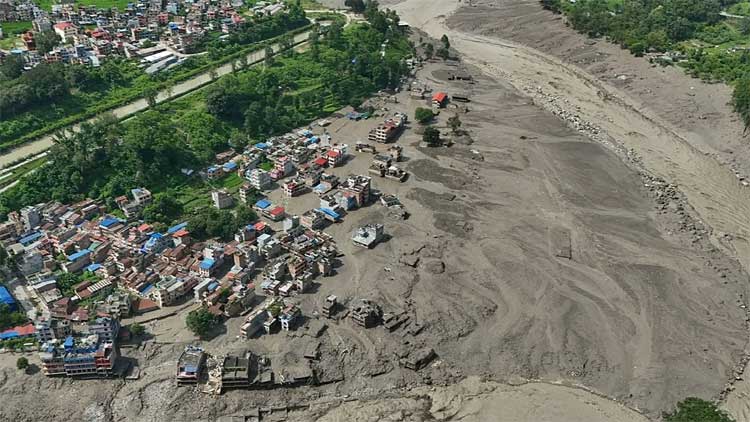
Massive flash floods swept through communities along the Nepal-China border on Wednesday, killing at least 160 people and leaving hundreds of tourists, workers and residents missing, as experts pointed to a likely glacier-related avalanche in the warming Himalayas as the cause.
Nepal police reported at least 157 deaths, while China’s state broadcaster CCTV said three people had died and 265 were missing in Tibet’s Gyirong County near the border. Drone footage showed torrents of muddy water tearing through roads and burying buildings, while vehicles, debris and infrastructure were swept away.
Nepalese officials said 403 people, including 341 foreign nationals, had been reported missing. Among them were 133 Indians travelling on a pilgrimage to Mount Kailash in Tibet. Missing foreigners also included 47 US citizens, 34 Australians, 33 Britons and 24 Canadians.
At least 62 Nepali citizens were among hundreds of people trekking near Gosaikunda Lake in Rasuwa district, which borders Tibet’s Gyirong. At least 28 police personnel were also reported missing.
The floods destroyed at least 19 bridges and nearly 40 kilometres of roads. The Bhotekoshi River overflowed around 9 am, damaging villages and hydropower projects. Authorities warned people to stay away from the banks of several major rivers, including the Trishuli, Bhotekoshi and Narayani.
Nepal has asked India and China to assist with rescue operations. Prime Minister Narendra Modi spoke with Nepalese Prime Minister Balendra Shah and offered India’s support for humanitarian and relief efforts.
Several countries also reported missing nationals. South Korea said nine citizens working at a hydropower project were missing, while Malaysia reported losing contact with 11 citizens believed to be in Rasuwa. Russia said four of its citizens in the affected area were also missing.
The disaster was likely triggered by an ice-rock avalanche from a glacier, according to climate experts at the International Centre for Integrated Mountain Development. They said water levels in the Trishuli River rose by as much as nine metres in just half an hour, highlighting the extraordinary speed and force of the flood.
Experts said the Lhende Khola River, a tributary of the Bhotekoshi, experienced severe flooding after an ice-rock avalanche blocked the river before releasing a sudden surge downstream.
The same region experienced a similar disaster last year when a glacial lake in Tibet overflowed amid high temperatures, killing nine people and damaging critical infrastructure, including a bridge linking Nepal and China.
Scientists have warned that the Hindu Kush Himalaya is becoming increasingly vulnerable to extreme rainfall, floods, landslides and rapid glacier melt as global temperatures rise. Research has found that glacier ice loss across the region has accelerated sharply since 2000, increasing the risk of sudden and destructive flooding.
Comments are closed.