
The Footprints That Matter: How Responsible Tourism Is Redefining the Future of Travel
When Every Journey Leaves a Legacy


Travel has always been about discovery. Today, however, the greatest discoveries are no longer limited to spectacular landscapes, historic monuments, or iconic skylines.
They are found in communities that protect their heritage, destinations that restore fragile ecosystems, and tourism businesses that measure success not only by visitor numbers but by the positive legacy they leave behind.
As the global tourism industry continues its remarkable recovery, a profound transformation is underway. Travelers are increasingly asking a different question before booking their next journey: How can my visit make a positive difference?
The Future of Travel Is Not More Tourists—It’s Better Tourism
Responsible tourism is emerging as one of the defining movements shaping the future of travel. It encourages every stakeholder—governments, tourism boards, businesses, local communities, and travelers—to create experiences that benefit people, preserve culture, and protect the environment.
Unlike conventional tourism, responsible tourism is not a niche segment. It is an approach that influences every stage of the travel experience. It begins with reducing environmental impact through efficient transportation, sustainable accommodations, and responsible resource management. It continues by supporting local economies, respecting indigenous traditions, promoting authentic cultural exchanges, and ensuring tourism contributes to long-term community development.
Across the world, destinations are demonstrating that sustainability and economic growth can work hand in hand. Coastal communities are restoring marine ecosystems while creating new livelihoods through eco-tourism. Rural villages are welcoming visitors with locally owned homestays that preserve traditional architecture and generate income for families. National parks are introducing visitor management systems that protect biodiversity while improving the quality of the visitor experience.
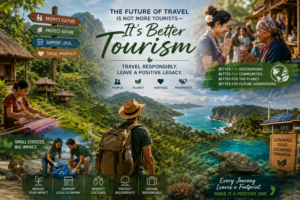
These initiatives share a common principle: tourism should leave destinations better than it found them.
Technology is also accelerating this transformation. Digital visitor management systems help prevent overtourism in fragile destinations. Artificial intelligence assists in forecasting visitor flows and reducing congestion. Renewable energy is powering an increasing number of tourism facilities, while circular economy practices are reducing waste generated by hotels, restaurants, and attractions.
Equally important is the growing role of destination marketing organizations and national tourism boards. Increasingly, promotional campaigns are no longer focused solely on attracting more visitors. They emphasize attracting the right visitors—those who appreciate local culture, respect natural environments, and contribute meaningfully to local economies.
Travel media has an equally significant responsibility.
For decades, travel journalism often celebrated destinations through lists of attractions and luxury experiences. Today, journalists have the opportunity to tell deeper stories—stories about conservation projects, community entrepreneurs, women-led tourism initiatives, indigenous knowledge, climate adaptation, accessible tourism, and innovative solutions that inspire meaningful change.
Readers increasingly seek these narratives because they reflect the evolving values of modern travel.
Major international tourism events are also placing sustainability at the center of industry conversations. They bring together tourism boards, travel professionals, innovators, and policymakers to exchange ideas, showcase best practices, and encourage partnerships that advance responsible tourism worldwide. Such platforms demonstrate that sustainability is no longer an optional consideration—it is becoming a strategic priority for the global tourism sector.
The transition is not without challenges. Climate change, biodiversity loss, overtourism, and unequal economic benefits continue to affect many destinations. Addressing these issues requires collaboration across borders and sectors. Governments, private enterprises, local communities, and travelers all have roles to play.
For travelers, responsible choices may be surprisingly simple: choosing locally owned accommodations, respecting cultural traditions, reducing plastic consumption, supporting local artisans, minimizing food waste, and exploring destinations beyond overcrowded hotspots. Small actions, multiplied by millions of travelers, create measurable impact.
The future of tourism will not be defined solely by where people travel. It will be defined by how they travel.
Success should no longer be measured by record-breaking arrivals alone, but by healthier ecosystems, stronger communities, preserved cultural heritage, and meaningful visitor experiences.
Responsible tourism reminds us that every journey leaves a footprint. The challenge—and the opportunity—is to ensure that footprint becomes a positive one.
As the travel industry continues to innovate and evolve, responsible tourism offers something more enduring than any itinerary: the promise that exploration can become a force for conservation, inclusion, and shared prosperity. In a rapidly changing world, that may prove to be the most extraordinary journey of all.
Comments are closed.