
Andy Burnham: ‘King of the North’ sets sights on Downing Street after Starmer exit

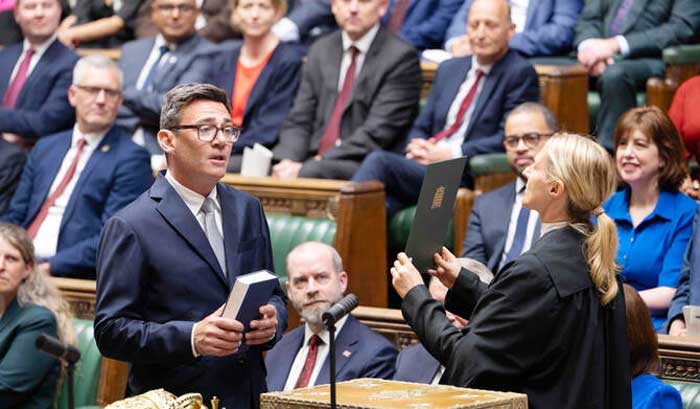
Andy Burnham received a hero’s welcome in the UK Parliament on Monday after Prime Minister Keir Starmer announced his resignation, fueling expectations that the veteran Labour politician could become the party’s next leader and potentially the country’s next prime minister.
Fresh from winning a parliamentary by-election, Burnham returned to Westminster as an MP and was sworn in before receiving cheers from Labour colleagues. He celebrated with supporters in the historic Westminster Hall, raising his fist and taking a selfie with around 200 Labour lawmakers.
Among those applauding him was Wes Streeting, a former cabinet minister who had been viewed as a potential rival for the Labour leadership before Starmer’s resignation. However, one MP interrupted the moment by shouting, “He’s not the messiah.”
Burnham’s return marks another step toward a long-standing ambition of leading Labour and entering Downing Street. After two failed leadership bids — losing to Ed Miliband in 2010 and Jeremy Corbyn in 2015 — the 56-year-old politician appears closer than ever to achieving his goal.
A Labour figure from the party’s “soft left” wing and a supporter of business-friendly socialism, Burnham first entered Parliament in 2001 and served in senior government roles under former prime ministers Tony Blair and Gordon Brown.
He left Westminster in 2017 to become mayor of Greater Manchester, where three election victories and his outspoken defense of the region earned him the nickname “King of the North.”
Following his recent by-election victory in northwest Makerfield, Burnham said his return was aimed at ensuring that areas long overlooked by Westminster receive greater attention.
From Westminster to Manchester’s political powerhouse
Born in 1970 into a working-class family near Liverpool, Burnham joined the Labour Party as a teenager before studying English at the University of Cambridge. He has spoken about struggling with “imposter syndrome” because of his working-class background.
A lifelong Everton supporter, Burnham became one of Britain’s most recognizable regional leaders during his time as Manchester mayor, particularly during the Covid pandemic when he clashed with Boris Johnson’s government over lockdown funding for northern England.
That confrontation strengthened his image as a defender of regional interests and helped create his “King of the North” reputation.
Burnham has also openly criticized Starmer’s leadership, especially over welfare cuts, arguing Labour needs a stronger left-wing identity.
His agenda in Manchester has focused on public transport, housing and healthcare, but critics say his national policy platform remains unclear.
Tony Travers, a professor at the London School of Economics, described Burnham as a strong communicator but said he had offered limited detail on tackling Britain’s cost-of-living pressures.
“He’s good at communication, but there is rather less detail,” Travers said, arguing Burnham may not be significantly more left-wing than Starmer.
Can Burnham stop Labour’s losses to Reform UK?
Former Conservative Prime Minister Boris Johnson warned Burnham that the challenges of national leadership would come quickly.
“The clock is ticking, your honeymoon will not last long,” Johnson said, comparing future political challenges to unexpected crises such as the Covid pandemic.
Burnham’s next major test could come in the Manchester mayoral election, where Reform UK leader Nigel Farage is hoping to make gains.
Analysts say Labour’s ability to hold the region could show whether Burnham’s popularity can prevent voters from moving toward the far-right party.
Burnham has promoted a political approach he calls “Manchesterism” — a combination of business support and socialist principles aimed at reducing inequality while encouraging growth.
However, economists warn his options may be limited by Britain’s financial pressures.
“The UK can’t tax itself much more, can’t borrow much more, and there isn’t much growth,” Travers said, highlighting the difficulties Burnham would face if he moves from regional leadership to national politics.
Comments are closed.