
Cristiano Ronaldo couldn’t finish, Bruno Fernandes couldn’t create: The story of Portugal’s frustrating World Cup opener

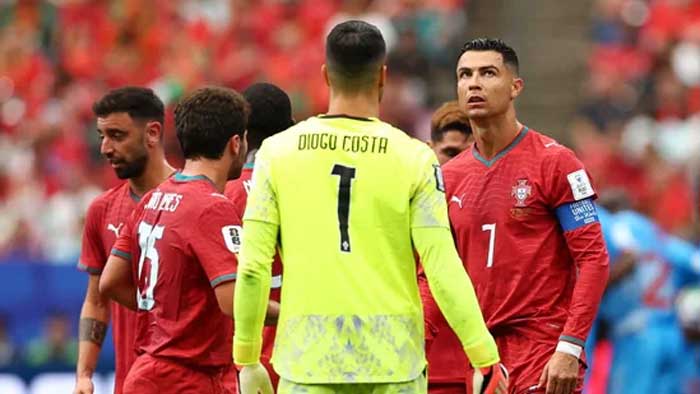
The World Cup has once again shown that reputation alone guarantees nothing. On football’s biggest stage, even the strongest teams can be punished if they fail to match the intensity and discipline of supposedly weaker opponents. Spain learned that lesson against Cape Verde, and Portugal received a similar wake-up call after being held to a 1-1 draw by DR Congo.
The result was one of the tournament’s early surprises. Portugal entered as overwhelming favourites but struggled to translate their dominance of possession into meaningful attacking opportunities. More concerning than the dropped points was the manner of the performance.
For a team featuring a midfield trio of Bruno Fernandes, Joao Neves and Vitinha—arguably among the most talented in the competition—alongside all-time leading international goalscorer Cristiano Ronaldo, Portugal managed just seven shots. It equalled their joint-lowest tally in a World Cup match, matching the seven attempts recorded against South Korea in 2002.
The statistic becomes even more striking when viewed alongside Portugal’s 783 completed passes. Despite controlling possession for long periods, Roberto Martinez’s side failed to convert that dominance into sustained attacking pressure.
DR Congo completed only 249 passes but produced eight shots—one more than Portugal. The contrast exposed the fundamental issue in Portugal’s display: plenty of possession, but little penetration.
Possession without purpose
Portugal circulated the ball comfortably and maintained territorial control for much of the match, but their attacks lacked urgency. The midfield struggled to play the line-breaking passes needed to disrupt DR Congo’s compact defensive structure, leaving Ronaldo isolated for extended periods.
Now operating primarily as a penalty-box striker rather than the all-action forward of his younger years, Ronaldo relies heavily on service from teammates. Against DR Congo, that service rarely arrived.
Had Joao Neves not scored within the opening 10 minutes, Portugal could have faced an even more difficult evening. DR Congo remained organised, disciplined and dangerous on the counterattack throughout the contest.
The match also marked a historic milestone for the African nation. Yoane Wissa scored DR Congo’s first-ever World Cup goal and helped secure the country’s first point in tournament history against one of Europe’s traditional powers.
Ronaldo and Bruno fail to deliver
Portugal’s attack continues to revolve around Ronaldo and Fernandes, but neither player managed to impose himself on the game.
Ronaldo finished with just 25 touches—the fewest he has recorded in a major tournament match for Portugal while playing the full 90 minutes. Confined largely to the final third, he rarely dropped deeper to influence build-up play and often appeared disconnected from the team’s attacking moves.
At 41, Ronaldo remains a threat inside the penalty area, but Portugal’s ability to maximise his strengths depends on creating regular opportunities around him.
That responsibility largely falls on Fernandes. Yet Portugal’s chief playmaker endured an unusually ineffective performance. Remarkably, he failed to create a single chance during normal time, with his first recorded chance creation arriving only in the 92nd minute.
Vitinha also struggled to provide the creative spark expected of him. Fresh from a Champions League-winning campaign with Paris Saint-Germain, he recorded 124 touches but created only one chance despite seeing plenty of the ball.
A growing concern for Ronaldo
Ronaldo’s goalscoring drought in major tournaments is becoming increasingly difficult to ignore.
The Portugal captain has now gone 10 consecutive World Cup and European Championship appearances without scoring. During that run, he has registered 33 shots, including 11 on target, without finding the net.
For a player whose legacy was built on delivering in decisive moments, those figures represent a significant departure from the standards he established throughout his career.
While Ronaldo continues to attract defenders and create space for teammates, questions about his effectiveness at the highest level are becoming more frequent.
Should Martinez make the difficult call?
Former Portugal coach Fernando Santos made headlines at the 2022 World Cup when he dropped Ronaldo for key knockout matches. The decision divided opinion but demonstrated a willingness to prioritise tactical considerations over status.
Ahead of the 2026 tournament, several pundits suggested Roberto Martinez may eventually face a similar dilemma.
The argument is not that Ronaldo should be excluded altogether. Rather, he could potentially offer greater value as an impact substitute, entering against tiring defenders during the final stages of matches.
Portugal’s draw with DR Congo is likely to intensify that debate.
A fresh Ronaldo entering around the hour mark could provide a different dimension with his movement, experience and finishing instincts. For now, however, Martinez appears committed to starting his captain.
Whether he is prepared to make a difficult but potentially transformative decision remains one of the key questions surrounding Portugal’s World Cup campaign.
What is already clear is that Portugal must find more effective ways to break down organised defences. Their next group-stage encounter against Colombia promises an even sterner examination. Colombia possess the structure, discipline and attacking quality to punish any repeat of Portugal’s sluggish display.
After an underwhelming start, Martinez’s side already looks like a team searching for answers.
Comments are closed.