
ED questions TMC’s Abhishek Banerjee for over nine hours in alleged teacher recruitment scam probe

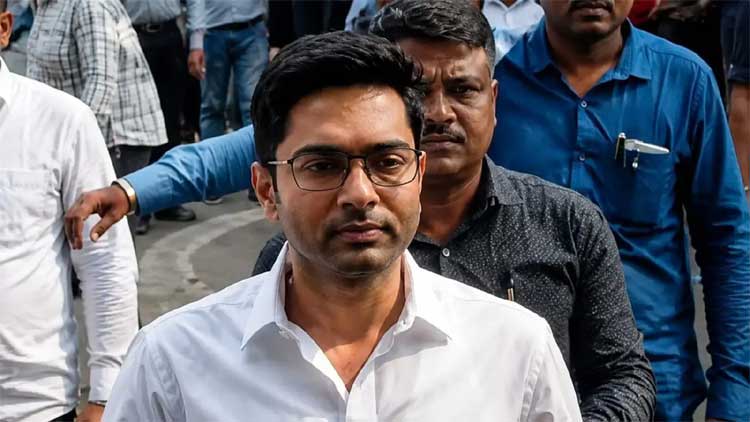
The Enforcement Directorate (ED) on Monday questioned Trinamool Congress (TMC) national general secretary Abhishek Banerjee for over 10 hours in connection with the alleged 2022 cash-for-jobs scam in West Bengal’s education sector, officials said. Banerjee appeared before the agency at its Salt Lake office in Kolkata’s CGO Complex around 11 am, with the interrogation continuing until nearly 9.30 pm.
The questioning came amid a deepening political crisis for the Trinamool Congress after at least 20 of its Lok Sabha MPs informed Speaker Om Birla on Sunday that they had merged with the little-known Nationalist Citizens Party of India (NCPI), a move that could significantly reduce the TMC’s strength in Parliament while boosting the numbers of the ruling National Democratic Alliance (NDA).
The rebel MPs submitted a letter to the Speaker stating that they had merged with the Tripura-based NCPI, a party formed in 2022 that currently has no elected representatives in any legislature in the country. A Lok Sabha official said Birla would first verify the signatures of the lawmakers before deciding whether to recognise the merger.
Rebels seek recognition under NCPI banner
After meeting the Speaker, rebel MP Kakoli Ghosh Dastidar said the group had decided to align itself with the NDA.
“We, 20 MPs, have merged with the Nationalist Citizens Party and will work with the NDA under the leadership of Prime Minister Narendra Modi and Amit Shah,” she said.
Nineteen MPs personally signed and submitted the letter to the Speaker, while first-time MP Rachana Banerjee, currently in Malaysia, conveyed her consent through the same communication, taking the total number of rebels to 20.
Abhishek Banerjee contests legality of move
Hours before the rebel delegation met Birla, TMC MPs Sagarika Ghose and Kirti Azad submitted a letter from the party’s Lok Sabha floor leader, Abhishek Banerjee, challenging the move.
In his communication, Banerjee argued that the anti-defection law no longer recognises a split within a political party and maintained that the All India Trinamool Congress remains a single, unified political entity.
Citing the Supreme Court’s judgment in the Maharashtra political crisis case, he said that lawmakers could not claim recognition as a separate faction while continuing to identify themselves as members of the same party.
“The AITC is a single, indivisible political party. There is in law only one AITC, one Leader of the Party in the House, and one Whip. No member or group of members can, by their own volition, create a parallel faction and seek separate recognition within the House,” the letter said.
Why the NCPI route was chosen
According to a BJP MP involved in the discussions, the NCPI was selected because it had previously contested elections in West Bengal, Tripura and Meghalaya despite lacking legislative representation.
The leader said the arrangement allowed the rebel MPs to retain a political connection with West Bengal while also projecting a broader regional identity linked to the Northeast.
Impact on parliamentary arithmetic
If the Speaker approves the merger, the NDA’s strength in the Lok Sabha would increase from 294 to 314 members. Despite the gain, the alliance would still remain 46 seats short of the two-thirds majority mark in the House.
In the Rajya Sabha, the NDA’s tally could rise to 155 seats, bringing it close to—but still below—the two-thirds threshold required for major constitutional changes.
Comments are closed.