
UN General Assembly set to debate resolution on countries’ climate change obligations

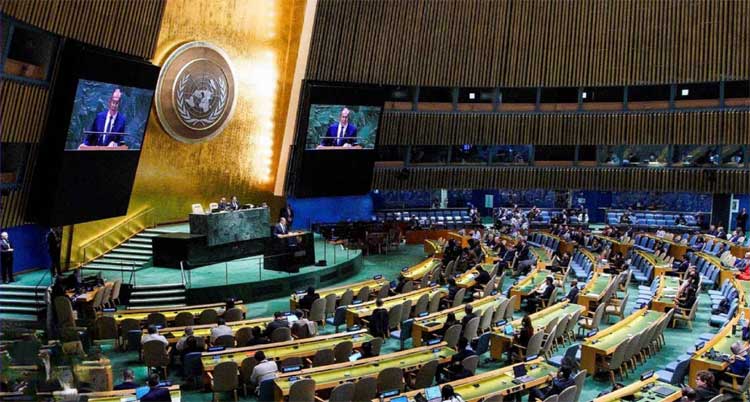
The UN General Assembly is set to consider a draft resolution on Wednesday reaffirming countries’ obligations to tackle climate change, though the long-awaited initiative has been diluted following pressure from major greenhouse gas emitters.
The push began in 2024 when the Pacific island nation of Vanuatu led efforts to seek an advisory opinion from the International Court of Justice on states’ responsibility to meet climate commitments. Last year, the court ruled that countries are legally obliged under international law to address climate change and warned that failure to do so could open the door to reparations for vulnerable nations.
The landmark opinion exceeded expectations among climate advocates, prompting Vanuatu to introduce a draft resolution earlier this year aimed at advancing implementation of the ruling. Although the ICJ opinion is non-binding, it can influence courts worldwide.
“For Vanuatu and for many climate-vulnerable states, this is ultimately about survival,” said climate minister Ralph Regenvanu, adding that the effort was also a test of whether multilateralism could still respond collectively to global challenges.
Negotiations, however, significantly softened the original text as several countries prioritised national security and industrial interests over stronger climate provisions. The current draft describes the ICJ opinion as an “authoritative contribution” to clarifying international law and urges states to comply with their obligations to protect the climate. It also reiterates the need to limit global warming to 1.5 degrees Celsius above pre-industrial levels, including through a transition away from fossil fuels in energy systems — a goal endorsed by nearly 200 countries at the 2023 Dubai climate summit.
One major proposal dropped from the revised draft was the creation of an “International Register of Damage” that would have documented climate-related losses and injuries. According to diplomatic sources, the idea faced opposition from the United States, China, the European Union, Japan and several oil-producing countries, many of which have consistently resisted measures that could expose them to compensation claims from climate-vulnerable nations.
Vanuatu has maintained that the resolution does not impose new legal obligations or assign blame to specific countries. Regenvanu described the text as “a careful and balanced response” to the ICJ guidance.
Despite the watered-down language, diplomats expect at least one country to demand a formal vote rather than adopting the resolution by consensus, as happened in 2024.
Climate advocates nonetheless welcomed the move. Joie Chowdhury of the Center for International Environmental Law said the draft still represented an important step toward climate justice despite intense political resistance.
Campaigners also hope the idea of a climate damage registry could return in the future, especially as the draft resolution asks the UN secretary-general to prepare a report outlining ways to improve compliance with obligations arising from the ICJ opinion.
Comments are closed.