
Bangladesh seeks China’s backing for Teesta River restoration project

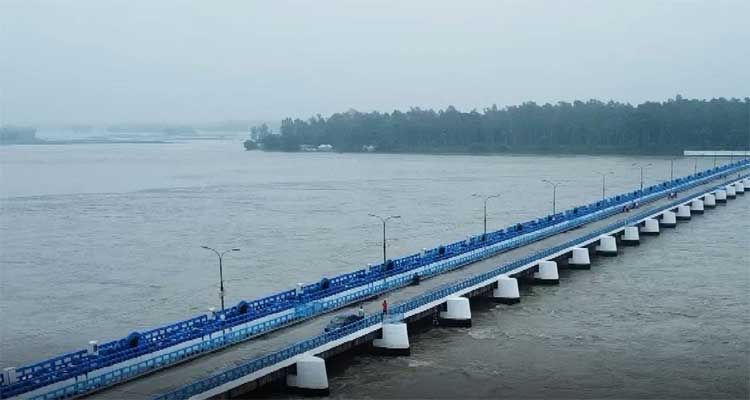
Bangladesh has formally sought China’s support for the restoration of the Teesta River, a move likely to draw close attention in India amid evolving regional dynamics and sensitivities around cross-border water sharing.
The issue was discussed during a meeting in Beijing on Wednesday between Bangladesh Foreign Minister Khalilur Rahman and Chinese Foreign Minister Wang Yi, according to Bangladesh’s state-run news agency.
The Teesta River, which originates in the eastern Himalayas, flows through Sikkim and West Bengal before entering Bangladesh, where it serves as a crucial source of irrigation and sustains millions of livelihoods.
The proposed Teesta River Comprehensive Management and Restoration Project has long been strategically significant because of its location near India’s sensitive Siliguri Corridor.
During the meeting, Wang expressed Beijing’s support for Bangladesh’s new government headed by Tarique Rahman and said China was ready to align high-quality Belt and Road cooperation with Bangladesh’s development priorities.
He also said China would encourage its companies to expand investment in Bangladesh, particularly in infrastructure and economic development.
According to the Chinese foreign ministry’s official readout, Wang stressed that China’s ties with Bangladesh and other South Asian countries “do not target any third party.”
Rahman’s visit marks his first official trip to China since the new government assumed office in February.
His earlier visit to India last month was closely monitored in Beijing, especially as the interim administration led by Muhammad Yunus had moved closer to China and Pakistan following the fall of Sheikh Hasina, straining relations with New Delhi.
India had offered technical and conservation assistance for the Teesta basin in 2024, reflecting its effort to deepen cooperation with Dhaka on transboundary river management.
Water sharing remains one of the most delicate issues in India-Bangladesh relations.
The 1996 Ganges Water Treaty between the two countries, which governs dry-season water sharing, is due to expire this year unless renewed.
The latest development also underscores China’s growing economic footprint in Bangladesh.
Chinese loans to Bangladesh since 1975 total around $7.5 billion, making Beijing Dhaka’s fourth-largest lender after World Bank, Asian Development Bank and Japan.
During Wednesday’s talks, both sides agreed to strengthen coordination under the China-Bangladesh Comprehensive Strategic Cooperative Partnership.
Bangladesh also reiterated its adherence to the One-China principle, reaffirming that Taiwan is an inalienable part of China and opposing any form of Taiwanese independence.
China, in return, reiterated support for Bangladesh’s sovereignty and the development path chosen by its people.
Comments are closed.