Open Hormuz, let global economy breathe: António Guterres warns of ‘empty fuel tanks and bellies’

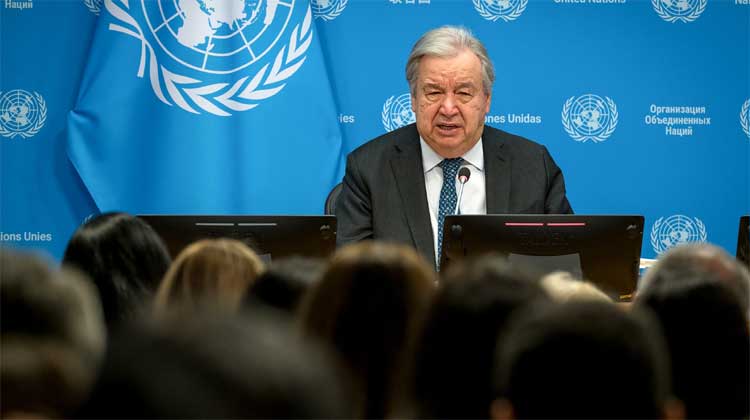
“Open the strait. Let ships pass. No tolls. No discrimination. Let trade resume. Let the global economy breathe.”
With this stark appeal, UN Secretary-General António Guterres on Monday urged immediate action to restore safe navigation through the Strait of Hormuz, warning that escalating disruptions are triggering a widening global economic and humanitarian shock.
Addressing a high-level debate at the United Nations Security Council, Guterres said the maritime security crisis—intensifying since early March—has sent shockwaves across energy markets, food supply chains and global trade. He cautioned that continued obstruction of the vital shipping lane could have severe consequences for economies and vulnerable populations worldwide.
“The economic shock has been immediate — and everyone is paying the price,” he said, pointing to volatile energy prices, soaring transport and insurance costs, and what he described as the most significant supply chain disruption since the COVID-19 pandemic and the war in Ukraine.
Carrying nearly one-fifth of the world’s oil and liquefied natural gas, along with a substantial share of global fertilizer trade, the Strait of Hormuz is one of the most critical arteries of international commerce. Guterres warned that prolonged disruption risks triggering widespread shortages, slowing the delivery of essential goods such as food and humanitarian aid.
He highlighted the timing of the crisis as particularly dangerous, coinciding with key planting seasons in many regions. Continued delays, he said, could push millions—especially in parts of Africa and South Asia—deeper into hunger and poverty, potentially sparking a global food emergency.
The burden is falling disproportionately on the most vulnerable nations, including least-developed countries and small island states that depend heavily on maritime imports. Meanwhile, more than 20,000 seafarers remain stranded at sea, with over 2,000 vessels navigating increasingly restricted and hazardous waters.
“These men and women are not parties to any conflict,” Guterres said. “They are civilian workers keeping the world supplied.”
He called for urgent support for evacuation efforts coordinated by the International Maritime Organization to protect affected crews, while reiterating the need for all parties to guarantee safe passage through the strait in line with international law, including the United Nations Convention on the Law of the Sea.
Framing the crisis as part of a broader breakdown in global cooperation, Guterres warned that rising geopolitical tensions are increasingly spilling into maritime domains.
“War and deepening divisions are shaking the collective security system,” he said. “Trust is eroding. International law is being violated — in plain sight.”
He urged renewed commitment to dialogue and restraint, stressing that maritime security must be safeguarded through collective action.
“The ocean must be a zone of peace and cooperation, not confrontation or coercion,” he said.
As supply chains strain and humanitarian risks grow, the unfolding crisis in the Strait of Hormuz is emerging not just as a regional flashpoint, but as a critical test of the international community’s ability to respond to shared global threats.
Comments are closed.