
Danish PM’s Left-Wing Bloc Wins Election, Falls Short of Majority

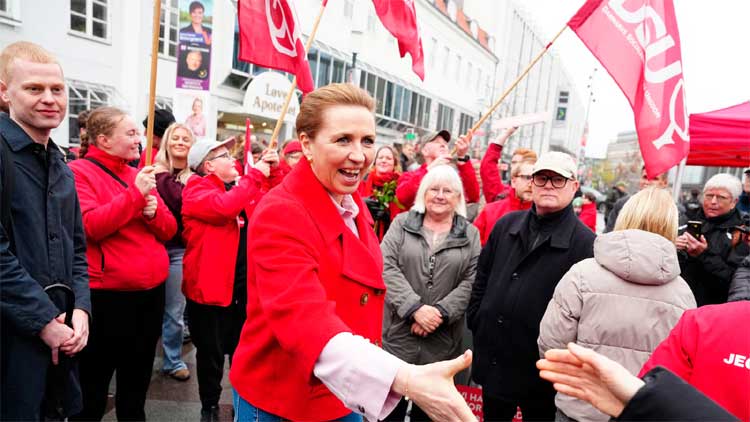
Denmark’s Social Democrats, led by Prime Minister Mette Frederiksen, emerged as the largest party in Tuesday’s general election but recorded their weakest result in over 120 years, while the left-wing bloc fell short of a majority.
With all votes counted in metropolitan Denmark, the left bloc secured 84 seats in the 179-member parliament, compared to 77 for the right, leaving both sides short of the 90 needed to govern. It remains unclear which side will ultimately be able to form a majority.
The centrist Moderates, led by Foreign Minister Lars Løkke Rasmussen, became kingmakers with 14 seats, setting the stage for complex coalition negotiations in the coming weeks. Rasmussen signaled support for a cross-bloc government, similar to the rare left-right coalition led by Frederiksen since 2022.
“We must not be divided. We must not be red or blue. We have to work together,” he told supporters.
However, his current coalition partner, Liberal Party leader Troels Lund Poulsen, rejected the idea of joining forces with the Social Democrats, saying his party would either form a centre-right government or move into opposition.
Far-right gains
Frederiksen, in power since 2019, had been seen as the frontrunner, bolstered by her handling of tensions with US President Donald Trump, who has repeatedly pushed to annex Greenland, citing US national security interests.
Despite that, the Social Democrats won just 21.8% of the vote — their lowest share since 1903 and a drop from 27.5% in 2022. All three parties in Frederiksen’s cross-bloc government lost ground.
On the left, Pia Olsen Dyhr said her party’s strong performance made it the second-largest on the left and gave it a mandate to push for welfare and green policies, while keeping open the option of staying in opposition.
Meanwhile, the anti-immigration Danish People’s Party, led by Morten Messerschmidt, saw a sharp resurgence, more than tripling its support to 9.1%.
Greenland factor and key issues
Four parliamentary seats are held by Denmark’s autonomous territories — two each from Greenland and the Faroe Islands — with Greenland’s votes still pending.
Greenlandic Prime Minister Jens-Frederik Nielsen described the situation as a “serious” moment, pointing to growing geopolitical pressure on the Arctic island.
While Greenland’s future and independence aspirations drew attention, the issue was not central to Denmark’s election campaign. Instead, voters focused on domestic concerns such as inflation, welfare, environmental challenges like nitrate pollution, and immigration.
Frederiksen has advocated stricter migration policies to curb far-right support, including controversial proposals such as limiting non-essential healthcare access for certain foreign nationals deemed a risk to medical staff.
With no clear majority, Denmark now faces a period of intense negotiations that will determine whether a broad cross-bloc coalition can emerge — or if political divisions deepen further.
Comments are closed.