
Old Guard vs New Wave: How Djokovic and Alcaraz’s Contrasting Weapons Will Shape the Australian Open Final

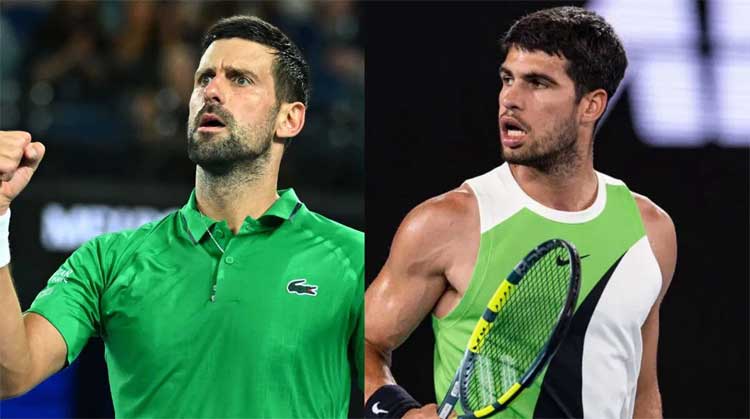
From being an afterthought in a tournament he has won a record 10 times, Novak Djokovic needed just one match to thrust himself back into the spotlight. Suddenly, the prospect of an unprecedented 25th Grand Slam title — and his first in more than a year — feels very real again at the Australian Open.
The rise of tennis’s new order, led by Jannik Sinner and Carlos Alcaraz, had pushed Djokovic’s pursuit of Margaret Court’s all-time record into the background. With the pair sharing the last eight major titles, the 38-year-old Serb was quietly being written off. Until Friday night.
Under the lights at Rod Laver Arena, Djokovic delivered another masterclass, ending two-time defending champion Sinner’s reign to reach his first Grand Slam final since Wimbledon 2025.
Now, he stands on the brink of a record-extending 11th Australian Open crown and a place in history as the oldest men’s singles Grand Slam champion of the Open Era.
Clash of Generations
Standing in his way is Carlos Alcaraz, 16 years his junior, who has reached his maiden Australian Open final and is chasing his own slice of history — the chance to become the youngest man to complete a Career Grand Slam.
“History is on the line for both of us every time we play,” Djokovic said. “A Grand Slam final has a lot at stake, but it’s no different from any other big match.”
Alcaraz arrives in Melbourne in scintillating form. Over the past 18 months, he has added two major titles and reclaimed the world No. 1 ranking. Any doubts over his ability to thrive without long-time coach Juan Carlos Ferrero have been firmly dismissed.
His semifinal win over Alexander Zverev — a five-set marathon lasting more than five hours — showcased both his resilience and evolution.
Tactical Battle
One of the biggest improvements in Alcaraz’s game has been his remodeled, Djokovic-like serve. A high first-serve percentage could help neutralize the greatest returner in tennis history.
The 22-year-old also carries belief. He defeated Djokovic in last year’s US Open semifinal and the 2024 Wimbledon final, both in straight sets. But those wins also underline a warning: avoid dragging the Serb into a five-set war.
Djokovic thrives when physical battles turn into mental contests on the biggest stages.
For Alcaraz, variety will be essential — mixing pace, height, and angles, and using his athleticism to stretch rallies. Sinner’s failure to consistently disrupt Djokovic’s rhythm in the semifinal proved costly.
Yet Djokovic knows how to counter such creativity. He has beaten Alcaraz five times in nine meetings, including their 2025 quarterfinal clash in Melbourne. After losing the opening set that day, Djokovic responded ruthlessly — flattening his groundstrokes, attacking earlier, and dominating key moments to close the match in four.
To repeat that performance, he must maintain aggression and avoid the passive phases that surfaced earlier in the tournament.
Simply trying to out-hit Alcaraz, as he did against Sinner, is unlikely to work. Against the world No. 1, Djokovic will need to outlast him.
Numbers Under Pressure
Both players have been formidable in tight moments. Alcaraz has won a tournament-high 76% of points at 30-30 and deuce, while Djokovic has claimed nearly 70% — the best figure among finalists.
It sets the stage for a final defined by nerve as much as skill.
Verdict
On form alone, Alcaraz appears primed. He is younger, fitter, and chasing history.
But this is Djokovic. In Melbourne. In a final.
Prediction: Djokovic in four sets.
Comments are closed.