
‘We don’t approve’: Army chief rejects China’s claim over Shaksgam Valley

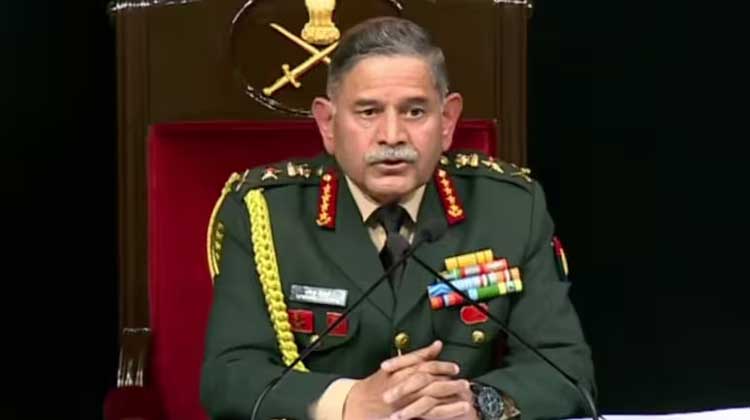
Army chief General Upendra Dwivedi on Tuesday firmly rejected China’s claims over the Shaksgam Valley, reiterating that India considers the 1963 China-Pakistan Boundary Agreement — under which Islamabad ceded 5,180 sq km of Indian territory in Pakistan-occupied Kashmir to Beijing — to be illegal and invalid.
His remarks came a day after China reaffirmed that the Shaksgam Valley belongs to it and defended its right to build infrastructure in the region. “We do not approve of any activity in Shaksgam Valley,” Dwivedi said at his customary press conference ahead of the 78th Army Day on January 15. He underlined that India does not recognise the China-Pakistan Economic Corridor (CPEC), which passes through Indian territory under Pakistan’s illegal occupation.
“We do not accept the statement issued in China on CPEC and consider it an illegal action being carried out by the two nations,” the army chief said.
On Monday, China’s foreign ministry spokesperson Mao Ning said Beijing’s infrastructure projects in the Shaksgam Valley were “beyond reproach,” asserting that China and Pakistan had lawfully demarcated their boundary in the 1960s. India has strongly rejected this position, maintaining that the Shaksgam Tract — including the valley north of the Karakoram watershed — is part of the erstwhile state of Jammu and Kashmir and has been illegally occupied by China since 1963.
Earlier this month, external affairs ministry spokesperson Randhir Jaiswal said India has never recognised the so-called boundary agreement between China and Pakistan and has the right to take measures to safeguard its interests in the region.
On the broader situation along the northern borders, General Dwivedi said conditions along the Line of Actual Control (LAC) remain stable but require constant vigilance. He noted that apex-level engagements, confidence-building measures and renewed contacts are contributing to gradual normalisation. The resumption of patrolling in Demchok and Depsang in eastern Ladakh in 2024, after a gap of more than four years, has restored ground positions to the pre-April 2020 status, he said.
Dwivedi added that both India and China are making efforts to build trust and maintain calm along the borders, with expert and working groups focusing on boundary delimitation and management.
On Pakistan, the army chief said terrorist-initiated incidents have dropped to almost zero following Operation Sindoor, India’s military response to the April 22 Pahalgam terror attack. However, he warned that eight terror camps remain active in Pakistan and Pakistan-occupied Kashmir, housing an estimated 100–150 militants.
“Operation Sindoor demonstrated India’s readiness, precision and strategic clarity,” Dwivedi said, warning that any future misadventures would be met with a resolute response.
Comments are closed.