
Iran Protests: President Pezeshkian Warns ‘Rioters’ Against Disrupting Society

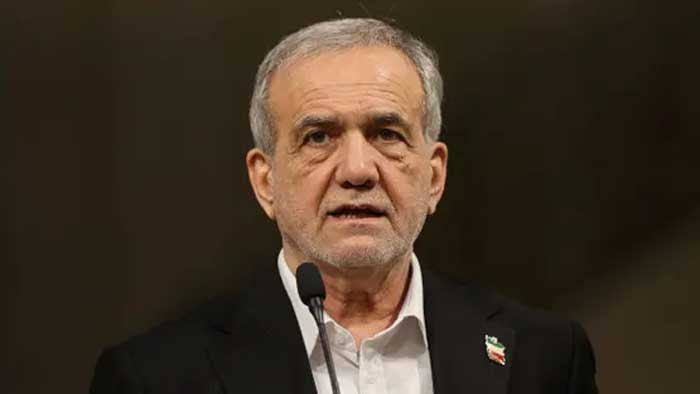
As intensified anti-government protests continue across Iran, President Masoud Pezeshkian on Sunday warned that “rioters” should not be allowed to disrupt society, marking his first public remarks since three consecutive nights of heightened unrest.
The protests began on December 28 in several markets in the capital, Tehran, triggered by mounting economic distress. The movement gained momentum in subsequent days as university students joined demonstrations against soaring inflation and the sharp decline of the Iranian rial.
More than 100 people have reportedly been killed since violence escalated on Thursday, when large crowds poured onto the streets following calls by exiled former crown prince Reza Pahlavi for stronger action against the government led by Supreme Leader Ayatollah Ali Khamenei.
What the Iranian President Said
In an interview with state broadcaster IRIB, Pezeshkian acknowledged that “protesting is the people’s right,” but echoed the government’s longstanding position by distinguishing between peaceful demonstrators and what authorities describe as “rioters.”
“The people should not allow rioters to disrupt society,” Pezeshkian said. “The people should believe that we want to establish justice.”
He said the government was prepared to listen to public grievances. “If people have concerns, it is our duty to hear them and solve their problems,” he said, adding that preventing disorder remained the administration’s “highest duty.”
Pezeshkian accused the United States and Israel of attempting to exploit economic grievances to fuel unrest. He alleged that individuals had been trained both inside and outside the country to escalate violence, claiming that “terrorists were brought in from abroad.” Referring to reports of a mosque being set on fire, he described those responsible as “not human.”
Situation on the Ground
Since Thursday, protests have spread to multiple cities, reflecting growing resentment against Iran’s clerical establishment that has governed the country since the 1979 Islamic Revolution.
The government has responded by restricting internet and telephone services, effectively placing large parts of the country under a communications blackout.
The US-based Human Rights Activists News Agency (HRANA) said on Sunday that more than 200 people, including women and children, had been violently detained by security forces.
“The pattern of protests in the capital has largely taken the form of scattered, short-lived, and fluid gatherings, shaped by the heavy presence of security forces and increased field pressure,” HRANA said. It also reported surveillance drones and heightened security deployments around protest sites.
Despite restrictions, videos of demonstrations have surfaced online, believed to have been transmitted using satellite internet services such as Starlink. The Associated Press cited footage from Mashhad, Iran’s second-largest city, showing protesters confronting security forces.
Iranian state television, meanwhile, aired live street reports from several cities on Sunday morning showing calm conditions, with on-screen date stamps. Notably, coverage did not include Tehran or Mashhad.
Comments are closed.