
Rare Saudi Desert Snowfall Sends Stark Climate Warning for India

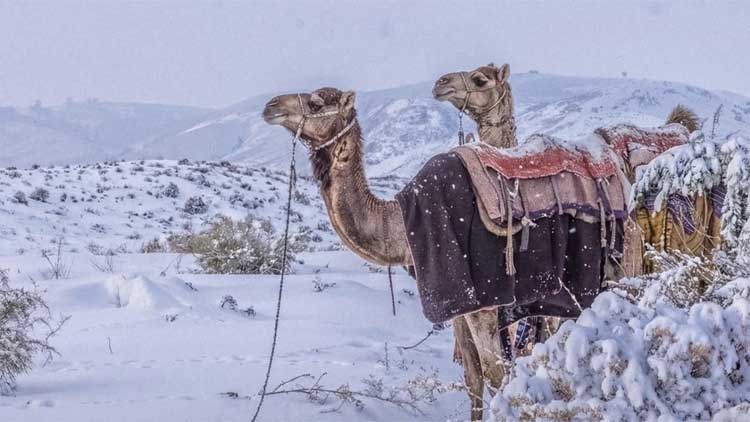
Snowfall in Saudi Arabia is rare. But what unfolded this winter across parts of the kingdom’s northern regions was both exceptional and unsettling.
Areas such as Tabuk and nearby mountainous zones saw temperatures plunge, hills blanketed in white and weather alerts issued — scenes more typical of cold climates than desert landscapes. Videos of snow-covered sands quickly went viral, not just for their novelty but for what they signalled: a climate system undergoing fundamental change.
The episode underscored a reality that is becoming harder to ignore. Climate change is no longer a distant or abstract threat. It is unfolding in real time, often in ways that defy historical patterns.
Climate extremes on the rise
One persistent misconception is that climate change simply means rising temperatures everywhere. Scientists say the opposite is true. As the planet warms, the atmosphere holds more moisture and energy, disrupting long-established weather systems and increasing volatility.
That is why the world — including India — is witnessing more intense heatwaves, extreme rainfall and sudden cold events in places where they were once rare.
India experienced this instability first-hand this year. Record-breaking heatwaves scorched large parts of the north and centre, followed by deadly cloudbursts in Uttarakhand, Himachal Pradesh and Sikkim. A delayed and erratic monsoon in some regions triggered devastating floods in others.
These events are not isolated. They are symptoms of a climate system under growing stress.
Why India must prepare
For India, the warning is not about freak snowstorms but about systemic risk. Agriculture, water management, urban planning and energy demand all depend on predictable seasonal cycles. As those cycles break down, the consequences multiply — from crop losses and water scarcity to urban flooding and heat-related deaths.
Adaptation has become urgent. Heat-resilient cities, robust early-warning systems, flood-proof infrastructure and climate-smart agriculture are no longer optional. Mitigation remains critical, but adaptation is now unavoidable.
Saudi Arabia’s snowfall should not be dismissed as a viral curiosity. It is another data point in a world where the climate is becoming more volatile and less forgiving. As warming accelerates, such anomalies are expected to grow more frequent.
The message is clear: the climate crisis is no longer knocking at the door. It is already inside.
Across the globe, Southeast Asia has seen relentless floods displace millions. Parts of Africa have swung between drought and torrential rain, crippling agriculture. South America has experienced unusual temperature spikes that disrupted ecosystems and power supplies.
Developing nations are bearing the brunt. Dense populations, fragile infrastructure and climate-dependent livelihoods mean even short-lived weather anomalies can quickly escalate into humanitarian and economic crises.
These concerns were also at the centre of discussions at this year’s COP30 climate summit in Belém, Brazil.
Comments are closed.