
Drop Blockade Imposed by US, Cuba Urges in Resolution Submitted to UNGA

For the 33rd time, the United Nations General Assembly (UNGA) will deliberate on Cuba’s annual resolution seeking an end to the decades-old US blockade against the island nation. The discussion and vote are scheduled for October 28–29, 2025.
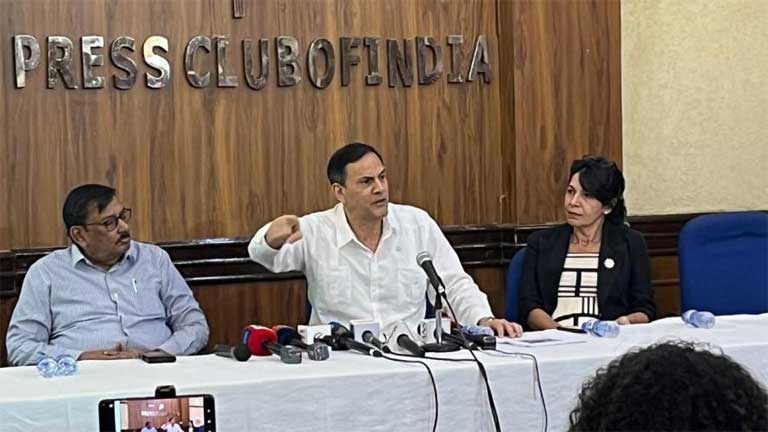
At a press conference held at the Press Club of India on Thursday, Cuba’s Ambassador to India, Juan Carlos Marsan Aguilera, expressed optimism that India — a “long-standing friend of Cuba” — would once again support the resolution.
“Last year, 183 countries voted in favour of our resolution. Only the United States and Israel opposed it, while Abu Dhabi abstained,” the Ambassador said.
Presenting the text of the resolution, Aguilera described the 65-year-old US economic, commercial, and financial blockade as a policy of “extraterritorial scope motivated by political reasons,” which he said remains the “main obstacle to Cuba’s development.”
Citing statements from the US Secretary of State, the resolution underscores Washington’s intent “to cut off all possible sources of external income for Cuba.” It adds that the US measures aim to “harm tourism, sabotage international medical cooperation, obstruct remittances and trade, and intimidate foreign investors,” thereby disrupting Cuba’s relations with other countries.
The Ambassador linked the origins of the blockade to retaliation after the Cuban Revolution, noting that prior to 1959, “almost 70% of land in Cuba was owned by US companies.”
The resolution also denounces Cuba’s inclusion on Washington’s list of “state sponsors of terrorism” as “dishonest and politically motivated.” It recalls that the country was removed from the list 10 days before former President Joe Biden left office, only for the decision to be reversed by his predecessor, Donald Trump.
Highlighting the humanitarian impact of the blockade, the resolution details how restrictions have hindered access to essential goods and services, including food, medicine, and fuel. Many international banks, it notes, have suspended operations with Cuba due to fear of US penalties.
Quantifying the blockade’s toll, the resolution states:
-
Two months of blockade losses equal the USD 1.6 billion needed to supply Cuba’s annual family food ration.
-
Four months of losses equal USD 2.85 billion, the amount required to purchase buses for the national transport system.
-
Sixteen days of losses equal USD 339 million, enough to meet the country’s annual essential medicine requirements.
While acknowledging the “almost unanimous support of the international community” over the past three decades, Ambassador Aguilera said Cuba continues to rely on global solidarity. “We hope that once again, as in the last 32 years, India and the majority of nations will vote in favour of our draft resolution,” he said.
Comments are closed.